
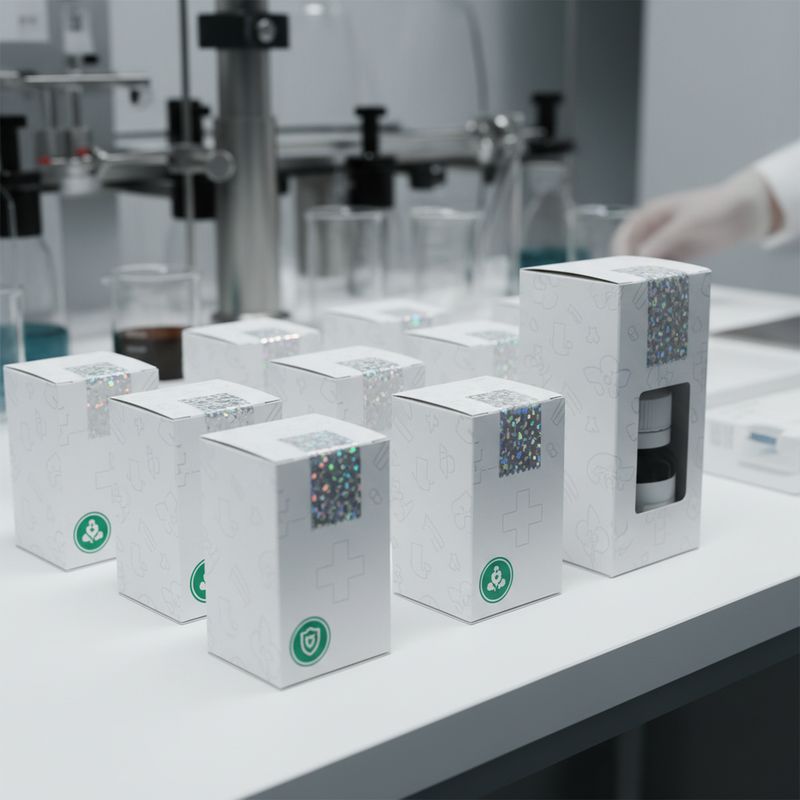
Pharmaceutical custom packaging with safety compliance is not simply a matter of printing a compliant-looking carton. It is a controlled pack system in which the primary container, closure, label, leaflet and outer box must work together to protect the medicine, communicate the right information and reduce avoidable misuse.
For UK buyers, the practical starting point is to define the medicine, route to market, user group and pack configuration before approving artwork or materials. The correct requirements can differ according to product category, dosage form, intended user, dispensing channel and whether the product is supplied as a medicine, healthcare product or another regulated item. Confirm the applicable UK requirements with the responsible regulatory and quality teams before production.
Pharma Packaging: Begin with the Product and Pack System
A pharmaceutical pack has several jobs at once. It must help preserve product quality, identify the product accurately, support safe handling and provide a reliable presentation through distribution, storage and use. Customisation should support those jobs rather than introduce unnecessary variation.
The first decision is to map every component in the pack system.
| Component | Main role | Questions to resolve before specification |
|---|---|---|
| Primary packaging | Directly contains the medicine, such as a bottle, blister or sachet | Is it compatible with the formulation? Does it provide the required barrier and closure performance? |
| Closure or dispensing feature | Seals the pack and controls access or dose delivery | Is it secure, usable and appropriate for the intended user? |
| Label | Identifies the product and carries essential information | What information must remain legible throughout the product life? Where will variable data appear? |
| Secondary carton | Protects, groups and presents the primary pack | Does it fit the filled product without crushing, rattling or damaging the label? |
| Patient information leaflet or insert | Provides instructions and safety information | Is there sufficient space, and can the insert be packed consistently? |
| Tamper-evident feature | Helps show whether a pack may have been opened | Is the feature clear, intact through handling and compatible with the pack-opening process? |
| Transit packaging | Protects packs during bulk handling and distribution | Does it prevent compression, abrasion, mix-ups and moisture exposure where relevant? |
Design from the inside out
A common error is starting with carton dimensions or a visual concept. Instead, begin with the item that directly holds the medicine. Its diameter, height, shoulder profile, seal, label area and closure all influence the final carton.
Build the secondary pack around verified dimensions, including reasonable manufacturing tolerances. A carton that is too tight can scuff labels, stress seals or make assembly difficult. One that is too loose can allow movement, causing damage and an untidy presentation.
For each pack format, document:
- the primary pack dimensions and permitted tolerance;
- product orientation inside the carton;
- leaflet or insert format and fold pattern;
- any tray, divider or support required;
- closure style and opening method;
- barcode, batch and expiry-code positions;
- tamper-evidence requirements;
- storage or handling constraints;
- artwork version and controlled copy;
- inspection criteria for the finished pack.
Choose materials for their function, not just appearance
Printed board, coatings, adhesives and finishes should be selected with the actual pack environment in mind. For example, consider friction during packing, resistance to scuffing, legibility of variable data and the performance of folds and glued areas.
Premium finishes can be suitable for certain over-the-counter or gift-style healthcare products, but they should not obscure warnings, make codes difficult to scan or interfere with visual inspection. Gloss, metallic effects and heavily patterned artwork can reduce contrast if used carelessly around critical text.
If packaging may be exposed to low temperatures, humidity, friction or repeated handling, those conditions should be included in the specification and assessed as part of the pack approval process.
Regulatory Design: Make Essential Information Easy to Find
Good regulatory design makes essential information visible, unambiguous and consistent across the complete product range. Compliance is not achieved by adding more text; it depends on hierarchy, contrast, spacing, version control and correct content.
The responsible product owner should provide approved copy and confirm what must appear on each packaging component. A packaging printer or carton supplier can help translate artwork into a manufacturable format, but cannot determine the legal status or required wording of a medicine on the buyer’s behalf.
Prioritise information hierarchy
The front, side and end panels should be planned around the information users, pharmacists, retailers and packers need to identify the product correctly. Exact requirements must be confirmed for the specific product, but a practical hierarchy often includes:
- Product name and strength or concentration.
- Dosage form and pack quantity.
- Active ingredient information where required.
- Key route-of-use or storage messages.
- Batch, expiry and other variable information.
- Barcode and identification data.
- Warnings, symbols and mandatory statements.
- Manufacturer, marketing authorisation or responsible-party details where applicable.
Do not rely on colour alone to distinguish strengths, flavours, formulations or similar stock-keeping units. Colour can support rapid recognition, but text, strength information and clear differentiation must remain dependable for people with impaired colour vision and in low-light dispensing environments.
Allow for variable data from the beginning
Batch numbers, expiry dates, serialised codes and other changing details need a defined print zone. Leave enough clear space for the selected coding method, including its expected character height, contrast and registration tolerance.
Variable data should not be placed:
- over busy images, varnish effects or metallic foils;
- across folds, glue flaps or carton creases;
- too close to a cut edge;
- where it may be hidden after opening;
- where scanning equipment cannot access it reliably;
- on a panel likely to be damaged in normal handling.
It is also important to agree who supplies the variable data, who approves it and how it is checked against the approved record. A visually attractive carton is not suitable if the batch or expiry information cannot be read consistently.
Control artwork versions and changes
Pharmaceutical artwork requires stronger change discipline than ordinary promotional packaging. Even a small alteration to a decimal point, ingredient statement, strength, warning or barcode can create a significant risk.
A controlled artwork process should include:
- a unique artwork identifier and revision number;
- named approval responsibilities;
- comparison against the previous approved version;
- sign-off on text, barcodes, colours and technical dielines;
- a clear rule for withdrawing obsolete files;
- records of approved proofs and production samples;
- separation of similar products during file handling and production.
Avoid approving artwork from a low-resolution screen preview alone. Request a suitable proofing process for the project and verify that all critical content, dimensions, overprint settings and codes are checked before a production order is released.
Child Resistant: Balance Restricted Access with Usability
Child-resistant packaging is designed to make access more difficult for young children while remaining usable for intended adult users. It is not the same as a carton that merely feels difficult to open, and it should never be assumed from an appearance or closure style.
Where child resistance is relevant, it normally concerns the complete accessible pack, especially the primary container and closure. A printed outer carton may contribute to pack integrity or tamper evidence, but it rarely makes a non-child-resistant container child resistant on its own.
Consider the actual access point
Review how a child could reach the product. Depending on the format, the relevant access point could be:
- a bottle cap;
- a blister cavity;
- a sachet opening;
- a pouch seal;
- a tube closure;
- a dispenser or pump;
- an inner tray or insert.
For bottles, the closure and neck finish must be compatible. For blister packs, the lidding material, push-through force and opening instructions may be central. For cartons, an additional locking feature should be evaluated carefully: it can improve security, but it may also frustrate older adults, people with limited dexterity or carers.
Do not confuse child resistance with tamper evidence
These features address different risks.
| Feature | Primary purpose | Typical indication |
|---|---|---|
| Child-resistant closure | Makes opening more difficult for young children | A push-and-turn or aligned-opening action on a suitable container |
| Tamper-evident feature | Shows whether the pack may have been opened or interfered with | A breakable ring, seal, label or carton tear feature |
| Senior-friendly design | Helps intended adult users open and handle the pack | Clear opening instructions, suitable grip and reasonable opening force |
| Security feature | Deters or reveals unauthorised access, diversion or counterfeiting | Features selected according to the product risk assessment |
A pack can have one, several or none of these features, depending on the product and its risk assessment. Do not describe a feature as child resistant, senior friendly or tamper evident unless it has been assessed and approved for the intended configuration.
Confirm the complete tested configuration
If child resistance is specified, ask what exact combination is being assessed: container, closure, liner, induction seal, label, carton and instructions can all affect use. A change in bottle supplier, cap material, carton geometry or opening wording may need review.
Before committing to a custom box, confirm:
- whether child resistance is mandatory, advisable or unnecessary for the product;
- the relevant current UK requirements or accepted test standard;
- which complete pack configuration is covered;
- whether the chosen carton changes access to the primary pack;
- whether instructions are understandable and prominent;
- whether accessibility has been considered for the intended adult population;
- how approved pack components will be controlled over time.
Secure Containers: Protect Product Integrity and User Confidence
Secure pharmaceutical containers help prevent leaks, contamination, loss of product and accidental access. The best solution depends on the medicine’s physical form, sensitivity and intended use.
A liquid may need a leak-resistant bottle and a closure that remains secure after repeated opening. Tablets may need moisture protection and a pack format that supports accurate use. A light-sensitive product may require an appropriate protective container, while a fragile primary pack may need a fitted carton, tray or divider.
Match the carton to the container
The secondary carton must support the primary pack without creating new problems. Check the fit using representative components rather than relying only on nominal drawings.
Key checks include:
- Headspace: enough room for the closure, seal and any label variation.
- Side clearance: sufficient protection without excessive movement.
- Orientation: clear definition of which way the product enters the carton.
- Retention: whether the product stays in position when the carton is opened.
- Opening: a closure that can be opened without tearing critical information.
- Reclosure: whether the carton needs to be retained or reclosed after opening.
- Leaflet fit: enough room for the approved folded leaflet without bulging.
- Transport strength: appropriate board and construction for the expected handling route.
Cartons are not automatically moisture barriers, leak barriers or temperature-control systems. If the medicine relies on a particular protective condition, identify which component delivers that protection and validate it through the appropriate product-quality process.
Use security features only where they solve a defined problem
Security details can include tamper-evident labels, perforated seals, tear strips, locking tabs, concealed opening points and traceability markings. Each feature brings trade-offs.
For example, a perforated opening can make first opening obvious but may weaken the carton. A tamper label may provide a visible seal but can interfere with recycling, decoration or opening instructions. A locking tab can help retain a bottle but may complicate automated packing.
Specify security features based on a risk assessment, then confirm that they work with the product, user journey, packing method and disposal expectations.
Check compatibility across the whole supply chain
A secure design can fail if it is incompatible with the way packs are filled, coded, stored or displayed. Before approval, check compatibility with:
- filling and cartoning operations;
- label application and inspection;
- batch and expiry coding;
- barcode scanning;
- leaflet insertion;
- bundling or multipack assembly;
- shelf presentation;
- e-commerce fulfilment where relevant;
- returns, recalls and stock segregation procedures.
B2B Production: Turn Requirements into a Controlled Brief
For procurement teams, a well-written specification is the best protection against avoidable ambiguity. It helps suppliers quote consistently, gives quality teams a common reference and reduces the chance that a visually similar but unsuitable carton is produced.
The brief should separate non-negotiable safety and regulatory requirements from visual preferences. A supplier needs both, but they should not be treated as equal.
What to include in a pharmaceutical packaging brief
Use this checklist when requesting bespoke cartons, labels or printed inserts:
- Product name, dosage form and pack size.
- Primary container drawings, samples or verified dimensions.
- Carton style, internal fit and finished size.
- Board type, thickness or strength requirement where defined.
- Required print colours and any colour-management reference.
- Artwork files, language versions and revision controls.
- Mandatory copy, warning areas and barcode requirements.
- Variable-data fields and coding location.
- Leaflet or insert dimensions, fold pattern and insertion orientation.
- Tamper-evident or security features.
- Child-resistant requirements, if applicable.
- Packing configuration and transit-pack needs.
- Inspection criteria and acceptable defect definitions.
- Sampling, approval and change-control expectations.
- Traceability, batch separation and record requirements.
- Responsibility for final regulatory and quality approval.
When comparing suppliers, assess more than the initial unit cost. Ask whether they can work from controlled specifications, manage approved artwork files, produce samples that reflect the final construction and identify technical risks before production.
Questions to ask a packaging supplier
A practical supplier discussion should cover the following:
- Can the carton structure be made to the verified dimensions and tolerances?
- What artwork format, dieline and proofing process are required?
- Which features may affect barcode readability or variable-data printing?
- How will similar artworks or multiple strength variants be distinguished?
- What sample type can be supplied for fit, assembly and approval checks?
- What production controls are available for approved artwork and revision handling?
- Which aspects must be supplied or approved by the buyer’s regulatory and quality teams?
- What changes would require reapproval of the carton or pack configuration?
XGolden Print provides custom printed packaging solutions and can be considered for bespoke carton requirements. As with any packaging partner, buyers should provide a controlled brief and verify that the proposed materials, construction and production approach meet their own product and compliance requirements.
For packaging formats beyond medicine cartons, explore custom printed boxes with the same focus on dimensions, artwork control and end-use suitability.
Common mistakes to avoid
Several errors recur when custom pharmaceutical packs are developed:
- Treating the outer carton as the sole compliance solution.
- Choosing a closure based on appearance rather than the complete pack requirement.
- Adding child-resistant language without validating the specific configuration.
- Leaving batch, expiry or barcode placement until after artwork is finished.
- Using colour as the only distinction between similar strengths or formulations.
- Ordering cartons before checking leaflet thickness and folded dimensions.
- Making a tamper feature difficult to understand or inconsistent with opening instructions.
- Approving a revised artwork file without a formal comparison to the current version.
- Assuming standard board or decorative finishes will suit the real storage and handling environment.
- Changing a pack component without reviewing impacts on fit, access, coding and approvals.
FAQ
Is a custom pharmaceutical carton enough to make a product compliant?
No. A carton is one component of a wider packaging and product-control system. Compliance depends on the specific product, required information, primary container, closure, labelling, quality processes and applicable UK obligations. Final confirmation should come from the responsible regulatory and quality functions.
Can a carton be child resistant?
A carton may include a locking or restrictive opening feature, but child resistance usually depends on the complete accessible pack and its specified performance. Do not assume that a difficult-to-open carton alone satisfies a child-resistant requirement.
What is the difference between secure and tamper evident packaging?
Secure packaging is a broad term that can cover access restriction, retention, traceability or anti-interference features. Tamper-evident packaging specifically helps indicate whether a pack has been opened or interfered with before purchase or use.
What should be approved before pharmaceutical packaging is printed?
At minimum, approve the controlled artwork, dieline, product fit, primary-pack compatibility, leaflet arrangement, barcode placement, variable-data zone, pack-opening method and any relevant safety or security feature. Confirm the approval route required by the product’s regulatory and quality teams.
How can buyers reduce mix-up risks across a product range?
Use distinct naming and strength hierarchy, clear version control, deliberate visual differentiation, barcode verification and controlled segregation of files and materials. Avoid relying only on similar shades or minor graphical changes to distinguish products.
A sound next step is to turn your pack requirements into a written specification, then review a physical sample using the actual container, closure, label and leaflet. This gives regulatory, quality, product and procurement teams a practical basis for approving a custom pharmaceutical packaging solution before production.