
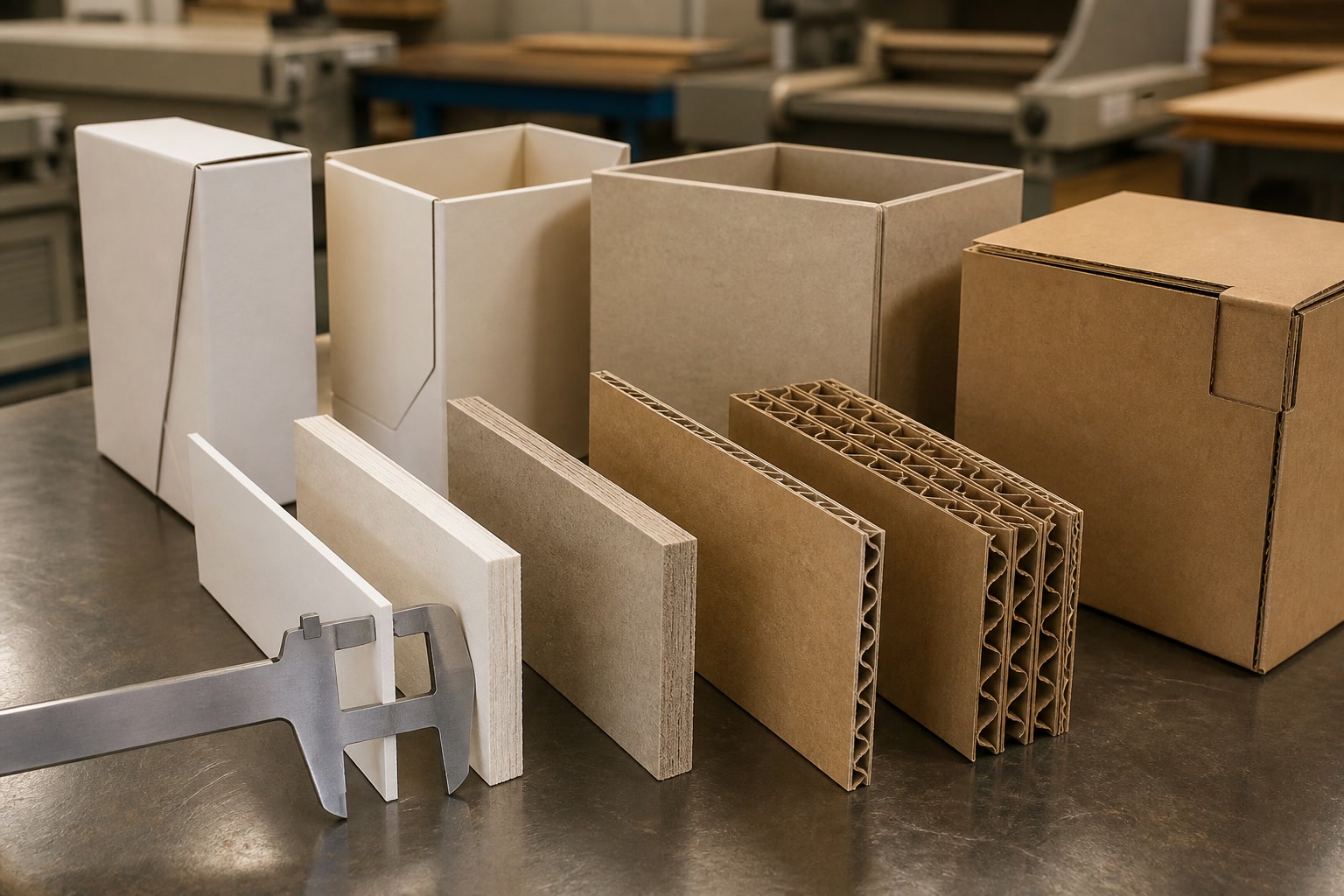
Paperboard thickness matters, but it does not determine box strength on its own. A thicker board can feel more rigid, yet still perform poorly if its fibre structure, grain direction, crease design or box construction is unsuitable for the product and supply chain.
To compare paperboard thickness and box strength properly, review grammage (g/m²), caliper (microns or mm), board grade, box style, product weight and the way packed boxes will be stored and handled. The right specification is the one that protects the product and presents the brand well without adding unnecessary material, cost or bulk.
Separate grammage, caliper and board grade
These terms are often used interchangeably in packaging discussions, but they measure different characteristics. Treating them as the same can lead to an unsuitable specification.
- Grammage, usually shown as gsm or g/m², is the weight of one square metre of board. It indicates how much material is present, but not precisely how thick, stiff or strong the finished box will be.
- Caliper is the physical thickness of the board, normally measured in microns (µm) or millimetres. A higher caliper can improve perceived quality and resistance to bending, although this depends on the board’s construction.
- Board grade describes the material composition and surface properties. It may indicate whether the board has coated printing surfaces, recycled content, virgin fibres, a white reverse, a kraft reverse or a layered construction.
Two boards can have the same grammage but different calipers. A bulkier board may be thicker because it has a more open fibre structure. That can be useful where shelf presence and stiffness are priorities, but it does not automatically mean it will resist crushing, tearing or repeated opening better.
Conversely, a denser board can be thinner at the same gsm. It may have a firm feel and a good printing surface, but may not provide the fold endurance or panel rigidity needed for every packaging format.
| Factor | What it measures | Why it matters for a box |
|---|---|---|
| Grammage (gsm) | Material mass per square metre | Useful starting point for comparing material use and weight |
| Caliper (µm/mm) | Physical board thickness | Influences bulk, tactile feel, crease behaviour and perceived sturdiness |
| Fibre structure | How fibres are arranged, bonded and layered | Affects stiffness, compression resistance, tear resistance and folding |
| Board grade | Surface, reverse side and material composition | Influences print finish, appearance, converting performance and intended use |
| Finished construction | Dielines, folds, flaps, glue areas and inserts | Determines how board properties become actual box performance |
For this reason, a brief saying “use 400 gsm board” is incomplete. It should also state the preferred board grade where known, the intended box style, product weight, dimensions, finish and any performance concerns.
What buyers should ask a supplier to confirm
When comparing quotations or samples, ask for the specification in a consistent format:
- Board grade or material description.
- Nominal grammage in gsm.
- Nominal caliper or thickness range, if available.
- Coated or uncoated surfaces and reverse-side appearance.
- Whether the board is suitable for the chosen print and finishing processes.
- The proposed box construction, including any inserts or reinforcement.
- Any variations likely to arise from lamination, embossing, foil or other finishes.
“Thick card” and “heavyweight board” are useful visual descriptions, not complete technical specifications.
Match board to product load and box style
The product load is not simply the item’s weight. Its shape, movement inside the pack, sharp edges, centre of gravity and how it is removed by the customer all affect the box specification.
A light but awkward product can create more stress than a heavier, compact item. For example, a glass bottle may place concentrated load on the base panel, while a long cosmetic item may push against end panels when the box is handled. A gift box containing several items may need reinforcement at the base even when each item is relatively light.
Start by defining the load in practical terms:
- Product weight: Include accessories, instruction leaflets, inner trays and any protective components.
- Weight distribution: Identify whether the load rests evenly on the base or concentrates at corners or edges.
- Product movement: Determine whether the item can shift during handling or transit.
- Product geometry: Consider sharp corners, rigid edges, bottles, jars and components that can puncture or abrade the board.
- Opening frequency: A box opened once needs different fold durability from a reusable gift or subscription box.
- Presentation requirement: Decide whether the pack must feel substantial in the hand, sit squarely on shelf or support premium finishing.
Box style changes the strength requirement
A board that works well for a simple carton may be inappropriate for a mailer or rigid presentation box. The construction changes how forces travel through the pack.
| Box style | Main strength considerations | Common specification focus |
|---|---|---|
| Straight tuck-end carton | Closure tabs, side seams, base panel and product fit | Accurate creasing, suitable fold strength and stable glue areas |
| Reverse tuck-end carton | Interlocking top and base, repeated handling | Fold endurance and reliable closure geometry |
| Sleeve | Resistance to scuffing, crushing and slipping | Panel stiffness, snug fit and suitable friction between surfaces |
| Drawer box | Pull force, tray rigidity and sleeve compression | Reinforced structure, tolerance control and smooth sliding |
| Folding gift box | Base support, corner stability and closure design | Board stiffness, strong creases and considered reinforcement |
| E-commerce mailer | Compression, impacts and opening experience | Structural design, corrugated material where appropriate and secure closure |
| Rigid box | Board thickness, wrapped corners and lid fit | Greyboard or similar rigid construction, wrap quality and dimensional accuracy |
For lightweight retail products, a folding boxboard-style carton may be appropriate where the focus is print quality and clean folds. For more demanding loads, a different construction, an insert, a reinforced base or a corrugated format may be more effective than merely increasing paperboard grammage.
This is an important buying principle: use structure to solve structural problems. Adding gsm alone can raise cost, affect creasing and create bulky packed dimensions without addressing the actual point of failure.
If you are comparing formats as well as materials, reviewing the available custom packaging box options can help frame the discussion around the intended product and use case.
Consider the full packed weight, not the item alone
A common mistake is to specify board based on an unboxed product sample. The finished pack may contain:
- An inner tray, card insert or divider;
- Leaflets, booklets or promotional cards;
- Multiple units or refill components;
- Added weight from glass, metal closures or magnets;
- Protective tissue, sleeves or seals.
Measure the packed product at the expected maximum configuration, not only the standard or minimum version. Where product weights vary across a range, specify against the heaviest practical pack-out.
Consider folds, grain and converting
Paperboard is not identical in every direction. During manufacture, fibres tend to align predominantly in one direction, commonly called the grain direction. Grain affects stiffness, folding behaviour and how well a box holds its shape.
The direction of a crease relative to the grain can influence whether a fold looks clean, springs back, cracks or becomes difficult to form. This is particularly relevant for premium cartons with dark print, solid colour areas, coatings, foils or laminated surfaces, where cracking at the fold is more noticeable.
Grain direction affects folding and rigidity
As a general principle, board usually folds differently with and across the grain. The best orientation depends on the box design and the panels that need the greatest stiffness or cleanest folds.
Rather than asking for a particular grain direction in isolation, provide the dieline and identify the critical requirements:
- Must the front panel remain flat for shelf display?
- Are there narrow side panels that may bow?
- Does the pack have a tight tuck flap?
- Will the box be opened and closed repeatedly?
- Are there full-bleed dark colours near score lines?
- Does the box include a window, perforation, hanger tab or tear strip?
A packaging converter can then assess grain orientation alongside the die-cut layout and board choice.
Creasing is not just a finishing detail
Creasing creates a controlled line along which the board folds. If the crease is too light, the fold may be inaccurate or prone to spring-back. If it is too aggressive, the board surface can crack, weaken or show visible stress marks.
Crease performance is affected by:
- Board caliper and density;
- Fibre composition and moisture condition;
- Grain direction;
- The relationship between cutting rule and creasing rule;
- Coatings, lamination and print coverage;
- Embossing or debossing near a fold;
- Folding speed and the particular box geometry.
Avoid assuming that a heavier board will convert more easily. Thicker material may need altered crease settings and can be unsuitable for small folds, narrow lock tabs or intricate structures.
Finishes can change the way a box behaves
Finishes improve appearance and may offer practical benefits, but they can affect folding, scuff resistance, slip and adhesive performance.
For example:
- Lamination can increase surface durability but may need careful scoring to avoid cracking or delamination at folds.
- Foil blocking can show stress more readily on sharply folded areas.
- Embossing may reduce local flatness and should be kept clear of critical glue zones where possible.
- Water-based or other coatings can alter surface friction and should be considered for sleeves, stacked cartons and automated packing.
Share the intended artwork and finishes before finalising board. A material that performs well as an unprinted blank may behave differently after printing and conversion.
Review stacking, handling and storage
The box has to perform beyond the point at which it leaves the packing bench. Even a well-designed carton can deform when exposed to excessive stacking, repeated handling or unsuitable storage conditions.
Think through each stage of its journey:
- Packing: Is the product inserted manually or mechanically? Does it catch on flaps or force panels outward?
- Internal movement: Will packed units be stacked on a warehouse shelf, placed in outer cases or stored upright?
- Distribution: Could the product be subject to vibration, drops, compression or variable humidity?
- Retail or fulfilment: Will staff repeatedly pick up the carton? Is it placed in a mailer, bag or shipping case?
- Customer use: Does it need to remain presentable after opening, gifting or storing at home?
Stacking loads are cumulative
A carton at the bottom of a stack supports more than its own contents. The real load depends on the number of units above it, the outer packaging arrangement, storage duration and how evenly the stack is distributed.
Do not rely on the board’s apparent stiffness in a single hand-held sample. A box may feel robust when empty but still buckle at the corners, bow at the panels or compress at the base when packed and stacked.
Where boxes are supplied as flat-packed cartons, also consider how they will be stored before packing. Board can respond to changes in moisture and temperature, which may affect flatness and converting behaviour. Keep packaging in clean, dry conditions and allow it to acclimatise where the production environment differs materially from storage conditions.
Outer packaging may be the real protective layer
Retail cartons and gift boxes are often designed chiefly for product presentation, not as standalone transit packaging. If products will be sent through parcel networks, assess the complete system:
- Primary carton or gift box;
- Insert, divider or cushioning;
- Inner case or protective wrap;
- Mailer or corrugated shipping box;
- Void fill and closure method.
Expecting a presentation carton to absorb all transit forces can lead to damaged products and disappointing unboxing. A well-fitting outer pack may allow the primary box to use a more suitable board for appearance and functionality rather than overbuilding it for shipping.
Avoid unsupported strength assumptions
There is no reliable rule such as “500 gsm is strong enough for 1 kg” or “a 600-micron board will always be twice as strong as a 300-micron board”. Such shortcuts overlook board grade, box dimensions, panel shape, crease layout, load concentration and real handling conditions.
Avoid these common assumptions:
- “Higher gsm always means a stronger box.” Higher grammage can help, but fibre structure and construction may matter more.
- “Thicker board is always better.” Excess thickness can complicate folding, increase packed volume and create poorly fitting closures.
- “One sample proves the specification.” An empty sample cannot validate performance under the true product load.
- “A rigid feel means transit protection.” Surface stiffness does not necessarily indicate impact or compression performance.
- “The board alone determines strength.” Glue areas, tuck design, die-cut tolerances, inserts and outer packaging are all part of the result.
- “A previous specification will suit a new product.” A minor change in product dimensions, contents or fulfilment method can alter the requirement significantly.
Board suppliers may provide technical data, but values should be interpreted in context. A laboratory material property is not automatically a prediction of finished-pack performance. If a performance claim is commercially important, agree the relevant test method, acceptance criteria and sample configuration rather than relying on general descriptions such as “durable” or “heavy duty”.
Confirm performance with representative samples
The most useful way to choose between paperboard options is to assess representative, converted samples with the real product inside. Samples should be as close as practical to the proposed final specification, including board, dimensions, printing, finishes, inserts and closure method.
A plain mock-up is valuable for checking size and product fit. It is less reliable for judging crease quality, scuffing, glue performance or the effect of coatings and printing.
A practical sample review checklist
Test the sample against the conditions it is expected to face:
- Pack the actual product at its maximum expected weight.
- Check whether the base remains flat and supported.
- Open and close the carton the expected number of times.
- Inspect folds for cracking, whitening, splitting or print damage.
- Check that flaps tuck correctly and do not pop open.
- Look for product movement, rattling or abrasion inside the box.
- Stack packed units in the likely retail or warehouse orientation.
- Place the carton inside its intended outer packaging.
- Review corners, seams and closure points after normal handling.
- Compare the finished appearance under the lighting likely to be used in retail or photography.
Document what “acceptable” means before reviewing samples. For example, decide whether minor crease whitening is acceptable, how much product movement is permitted and whether a carton must remain square after a defined period of stacking. This makes comparisons between options more objective.
Compare like with like
If you are considering two board options, keep as many variables as possible the same. Compare identical dielines, artwork coverage, finishes and product load. Changing the board, box design and insert at once makes it difficult to identify which change improved or reduced performance.
For higher-value, fragile or unusually shaped products, consider a staged approach:
- Confirm product fit with an unprinted structural sample.
- Assess the chosen board and crease design with a converted sample.
- Review the complete packaged system, including outer protection.
- Approve production only once the relevant performance and presentation points are met.
FAQ
Is gsm or microns more important for box strength?
Neither is sufficient on its own. Grammage indicates material mass, while microns indicate thickness. The board grade, fibre structure, box design, product load and folds determine how those properties translate into finished box performance.
What board thickness is suitable for a gift box?
The suitable thickness depends on the gift box style, contents and desired presentation. A lightweight item in a folding carton has different needs from a heavy item in a two-piece rigid box. Assess the product weight, base area, lifting method, inserts and whether the box must survive transit or only support presentation.
Does lamination make a paperboard box stronger?
Lamination can improve surface resistance and change the feel of a box, but it is not a substitute for an appropriate structural design. It may also affect creasing and folding, so it should be tested on the intended board and box style.
Can a thicker carton replace protective transit packaging?
Usually not. A thicker retail carton may improve rigidity, but it cannot necessarily protect against parcel-network impacts, compression and movement. Review the primary carton and outer shipping packaging as one system.
What should be included in a packaging specification?
Include the board grade, gsm, caliper where relevant, dieline, finished dimensions, print and finishing requirements, product weight, inserts, closure type, packing orientation and the conditions the finished pack must withstand.
The best paperboard specification is based on evidence rather than thickness alone. Define the product load and box style first, compare grammage, caliper and grade together, then review representative samples under realistic handling and stacking conditions. When developing a new pack, provide these details early so the proposed structure can be assessed before production.