
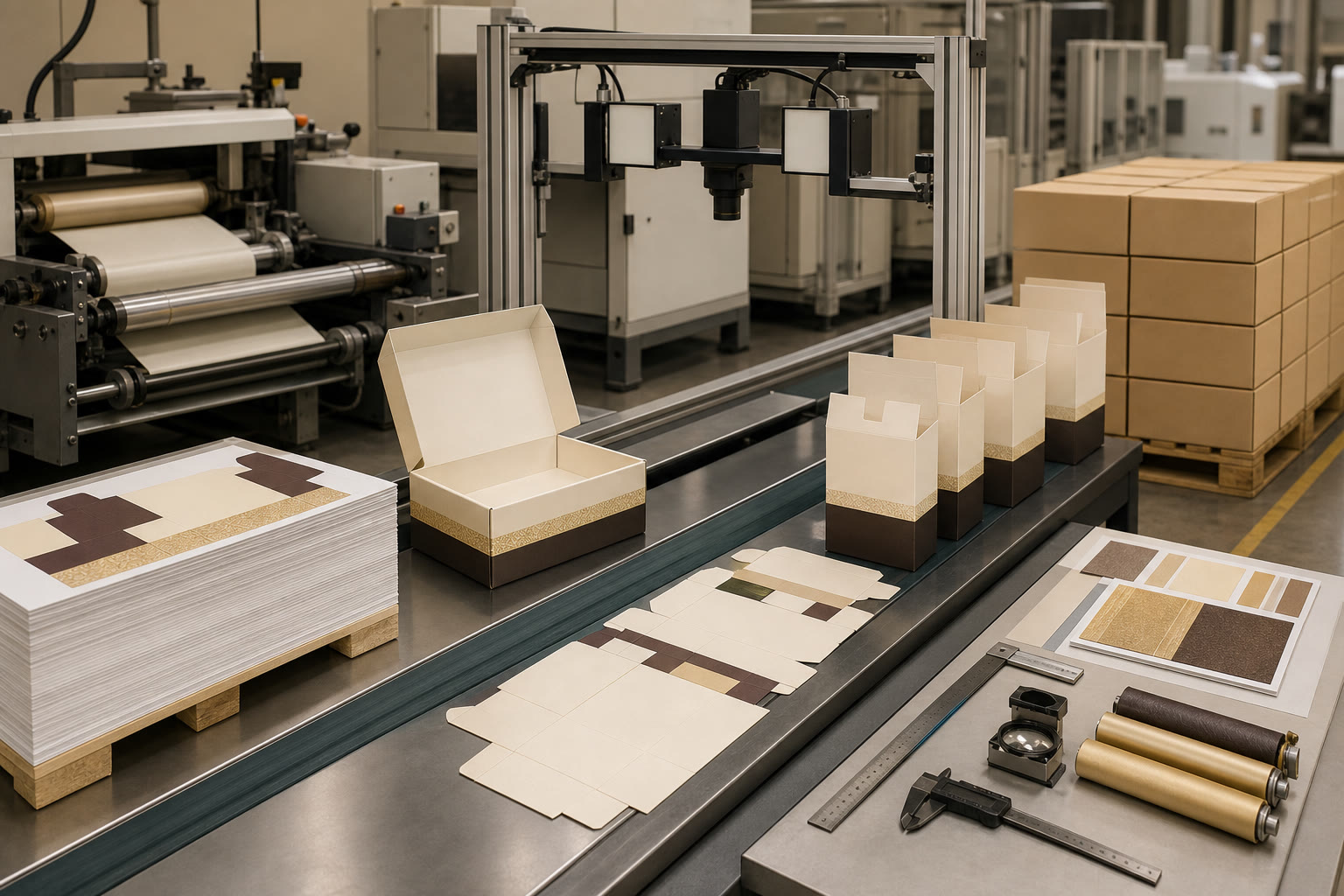
Packaging quality control checkpoints work best when they are based on a clear, agreed reference set rather than assumed “standard” tolerances. Before production begins, define what the finished packaging must look like, how it must function, which defects are unacceptable, and who can approve a departure from the agreed standard.
For custom cartons, gift boxes, labels and e-commerce packaging, quality control should follow the product through material receipt, first-off approval, printing, finishing, converting, assembly, pack-out and final release. This approach makes problems easier to contain while they are still limited to one stage, rather than discovering them after the order has been packed or delivered.
Approve materials and production references
The first packaging quality control checkpoint happens before the main production run. A good control plan starts with approved materials and a practical set of production references that inspectors, operators and buyers can use consistently.
The reference set should reflect the ordered product, not a generic example from a previous project. It may include:
- Approved artwork files, including version number and date
- A physical signed sample, where this has been supplied or agreed
- A colour target, proof or approved printed reference
- Material description, such as board grade, paper finish, label stock or adhesive type
- Construction drawing or dieline, including dimensions and fold positions
- Finishing requirements, such as lamination, foil, embossing, spot varnish or window patching
- Assembly instructions for rigid boxes, inserts, sleeves and multi-part packs
- Pack-out requirements, including quantity per bundle or outer carton
- A written list of agreed acceptance criteria and known acceptable variations
This is particularly important where several people are involved in specification. A brand manager may focus on appearance, a procurement colleague on the ordered material, and a fulfilment team on whether cartons stack, close and pack efficiently. The production reference needs to bring those requirements together.
What to check when materials arrive
Material checks should confirm identity, condition and suitability before the material is used. The specific checks depend on the item, but commonly include the following.
| Area | What to compare with the reference | Why it matters |
|---|---|---|
| Board or paper | Grade, finish, colour, sheet condition and visible surface variation | Affects print appearance, folding and perceived quality |
| Corrugated material | Flute profile, liner appearance, cut quality and moisture-related distortion | Influences protection, print finish and carton formation |
| Label stock | Face material, adhesive, release liner and roll direction | Determines application performance and presentation |
| Inks and coatings | Intended colour, finish and compatibility with the substrate | Helps prevent unexpected rub, gloss or colour outcomes |
| Foil and decorative materials | Colour, width, finish and intended application | Avoids a visible mismatch on premium packaging |
| Glue, tape or other assembly materials | Intended use, storage condition and compatibility with the pack | Supports reliable assembly and closure |
| Purchased components | Dimensions, finish, quantity and appearance of inserts, magnets, ribbons or handles | Prevents downstream assembly delays and mismatched parts |
Do not assume materials described with similar trade names are interchangeable. The same nominal paper weight, for example, does not guarantee the same stiffness, shade, coating response or folding behaviour. If material substitution might be acceptable, agree it in writing before it enters production.
Establish visual and functional priorities
Not every part of a pack deserves the same inspection intensity. A front-facing logo on a luxury gift box may require close visual scrutiny, while the inside of an outer transit carton may have less demanding cosmetic requirements. Make this distinction explicit.
A practical control plan separates requirements into three categories:
- Critical requirements: features that affect safety, legal information, product identification, functionality or the ability to use the pack.
- Major requirements: visible or structural features that materially affect brand presentation, assembly or product protection.
- Minor requirements: limited variations that do not affect the intended use or normal presentation of the packaging.
The exact classification is a commercial decision between buyer and supplier. Avoid claiming that a universal defect category or numerical tolerance applies to every packaging project. A reasonable level of colour variation, edge marking or board texture can differ substantially between recycled kraft packaging, high-end coated cartons and uncoated natural papers.
For projects involving custom printed boxes, agree which faces are customer-facing, whether the pack will be viewed at close range, and how it will be displayed. These details determine what a meaningful visual check looks like.
Review first-off output
First-off output is the first complete production example made using the intended materials, artwork, process and construction. Its purpose is to confirm that the job can proceed as specified before a larger volume is produced.
A first-off review is more useful than a simple “looks good” approval. It should compare the sample directly with the agreed references and confirm both visual quality and practical performance.
A first-off checklist for custom packaging
Review the following areas before authorising the main run:
- Artwork content: correct design version, copy, barcode, product information, symbols and language.
- Positioning: placement of logos, text, images, foil and varnish relative to cut, fold and panel edges.
- Colour appearance: comparison with the agreed proof or physical colour reference under a suitable viewing condition.
- Registration: alignment between printed colours, varnish, foil, embossing and die-cut features.
- Dimensions and construction: intended panel size, crease locations, openings, slots, windows and insert fit.
- Function: folding, closing, locking, opening, filling and, where relevant, label application.
- Finish: intended gloss, matt effect, tactile surface, foil coverage and overall visual consistency.
- Handling: whether surfaces scuff, crack, mark or delaminate during normal folding and assembly.
The first-off should also test the real interaction between parts. A carton that appears correct while flat may not close correctly after a coating is applied. An insert can fit a sample product but become difficult to use if board thickness changes. A label may look correct on its release liner but wrinkle or lift on the final pack surface.
Decide who gives approval and what it means
The control plan should state whether the first-off is approved by the buyer, a nominated representative, the supplier’s quality team, or a combination of these. It should also clarify whether approval permits full production or whether it is only a colour or construction reference.
Where a physical customer approval is not practical, a documented inspection record with photographs can still be helpful. However, photographs are not always reliable for judging subtle colour, metallic foil, texture, gloss or relief effects. For appearance-sensitive packaging, agree the most appropriate reference before the order starts.
A common mistake is approving a digital visual alone and later treating it as a complete production standard. Digital artwork confirms design intent; it does not automatically confirm the final response of ink, board, coating and finishing processes.
Check print finishing and converting stages
Quality should be checked at the stages where a defect can first occur. Waiting until the finished cartons are packed means avoidable waste, rework and uncertainty over how much stock is affected.
For printed packaging, the key stages often include printing, coating or lamination, decorative finishing, die-cutting, creasing, gluing and assembly. The actual sequence depends on the construction and specification.
Printing checks
Printing inspections should look beyond whether all elements are present. Inspectors should compare current output with the approved first-off or colour reference, watching for:
- Colour drift during the run
- Poor registration between colours
- Missing, weak or excessive ink coverage
- Set-off, smudging, streaking or hickeys
- Uneven solids or inconsistent tint appearance
- Incorrect variable information, where applicable
- Text or barcodes positioned too near a cut, crease or glue area
- Image reversal, omitted elements or use of an outdated artwork file
Colour needs to be assessed in context. Substrate shade, coating, lighting and viewing angle can change perceived colour. Metallic and fluorescent inks, foil and tactile finishes can be especially difficult to judge from photographs. The agreed reference should state whether colour matching is based on a printed sample, an approved proof, named colour values or another defined method.
Finishing checks
Finishing often creates the most noticeable premium effect, but it can also introduce defects that only become visible when the pack is handled. Check the particular finish against the agreed target.
For lamination, film coatings and varnishes, review:
- Surface coverage and edge adhesion
- Consistency of gloss, matt or soft-touch effect
- Bubbling, silvering, scratches or trapped debris
- Cracking around folds and creases
- Compatibility with glue areas and intended assembly
For hot foil, embossing, debossing or spot effects, check:
- Position relative to the printed artwork
- Complete and even transfer
- Sharpness of detail
- Unwanted foil marks or impressions
- Surface damage around the decorative area
- Visibility of the effect on the intended board and under normal handling
For printed labels and stickers, the control point should include the final application context where possible. Confirm label cut shape, print legibility, roll direction, release quality, adhesive suitability and whether the label sits correctly on the target pack surface. A label specification that works on smooth coated board may not perform the same way on a textured, curved or low-energy surface.
Converting and structural checks
Converting turns printed sheets into usable packaging. Small inconsistencies at this stage can affect assembly, filling and shelf appearance.
Check for:
- Die-cut accuracy and clean cut edges
- Correct crease depth and fold position
- Cracking or fibre exposure along folds
- Clean stripping of waste sections
- Correct perforations, tear strips, slots and locking tabs
- Window patch placement and adhesion, if included
- Glue position, volume and bond integrity
- Squareness and alignment of formed boxes
- Correct orientation of panels, inserts and sleeves
A useful approach is to take samples at planned intervals and after any material, machine or operator change. The frequency should suit the project’s complexity and risk, rather than following an unexamined universal schedule. More frequent checks are sensible where a short-run job has tight visual requirements, a multi-part construction, variable data or intricate decorative finishing.
Inspect assembly and pack-out
Assembly and packing are not merely logistics steps. They can introduce scuffs, mixed components, incorrect counts, deformation and orientation errors after the packaging itself has passed earlier inspection.
The pack-out checkpoint should confirm that the delivered goods remain usable for the buyer’s own operations, whether they are shipping online orders, supplying retail locations or preparing gift sets.
Assembly checks for formed packaging
For rigid boxes, folding cartons, presentation packs and inserts, inspect completed units for:
- Correct component combination and orientation
- Clean corners and aligned wrapped edges
- Secure magnets, ribbons, handles or other fitted components where specified
- Accurate insert location and product cavity fit
- Smooth opening and closing
- Reliable locks, tabs or adhesive bonds
- Absence of dents, pressure marks, scuffs, glue staining or loose fibres
- Consistent shape when stacked
If the buyer will pack a product into the carton, test a representative unit with that product or an agreed dimensional substitute. Packaging that closes empty may bow, split or become difficult to close once filled.
Pack-out checks
Outer packaging should protect the custom packaging without creating new defects. Confirm:
- Correct item count per inner bundle and outer carton
- Separation or protective packing where surfaces could rub
- Correct orientation to reduce crushing or corner damage
- Secure closure of the outer carton
- Clear identification of the job, version, quantity or batch reference where agreed
- No mixed artwork versions, sizes, finishes or components
- Reasonable stack stability for the intended handling route
The required outer-carton strength, pallet pattern and transit protection vary by product weight, distribution method and storage conditions. These should be agreed in the order specification, rather than assumed from the appearance of the finished pack.
Record non-conformance and decisions
A non-conformance is any confirmed departure from the agreed requirement. Recording it is not about creating unnecessary paperwork; it is how a team contains a problem, makes a clear decision and avoids repeating the same uncertainty at later stages.
A useful record identifies:
- Job or order reference
- Date and production stage
- Description of the issue
- Quantity inspected and quantity affected, where known
- Photographs or retained samples where useful
- Reference requirement that was not met
- Immediate containment action, such as hold, segregation, rework or additional inspection
- Decision maker and decision date
- Final disposition: accepted by concession, reworked, replaced, scrapped or otherwise resolved
- Corrective action, if one is needed to prevent recurrence
Separate defects from acceptable variation
Packaging is made from materials with natural and process-related variation. The presence of variation does not automatically mean a batch is defective. The question is whether it falls outside the reference-led criteria agreed for that job.
For example, slight fibre variation may be an expected characteristic of uncoated or recycled paper. In contrast, a missing section of foil on a prominent brand mark may be unacceptable even if it affects only a small area. The agreement should reflect the product’s positioning, sales channel, viewing distance and function.
Avoid vague instructions such as “premium quality”, “no marks” or “match the sample exactly” without defining what they mean in practice. Such wording can lead to disputes because it provides no workable inspection standard.
Manage concessions carefully
Sometimes a deviation is commercially acceptable, but it should not quietly become the new standard. If a buyer accepts stock with a visible variation, document this as a specific concession for the affected batch or order. State what is being accepted, why, and whether the acceptance applies to future runs.
This protects both sides from a later misunderstanding. It also ensures that a one-off decision does not override the approved sample or specification by accident.
Release finished cartons against agreed criteria
Final release should confirm that the finished quantity is suitable to dispatch against the agreed criteria. It is the last decision point, not the only quality check in the process.
The release reviewer should have access to the job specification, approved references, in-process inspection records and any non-conformance decisions. If an issue remains open, the goods should not be treated as fully released simply because the cartons are packed.
Final release checklist
Before dispatch, confirm that:
- The correct artwork, construction, material and finish have been used.
- First-off approval and relevant stage checks have been completed.
- Finished samples meet the agreed visual and functional criteria.
- Any defects found have been contained and resolved or formally accepted.
- Required quantities have been counted and correctly packed.
- Outer cartons are identified as agreed and are in suitable dispatch condition.
- No unapproved mixed versions, components or off-specification stock remain in the consignment.
- Release authority is recorded.
The final inspection method should be proportionate. A complex luxury pack may justify detailed examination of individual features, while a straightforward shipper carton may focus more strongly on dimensions, strength-related construction and count accuracy. For either, the right approach is the one tied to the actual order requirements.
Common mistakes in packaging quality control
Several avoidable errors weaken otherwise capable production and inspection processes.
Relying on verbal instructions
A request such as “use the usual board” or “make it like last time” is risky unless the relevant version, sample and material details are clearly identified. Record changes to artwork, stock, finish and construction.
Checking appearance but not use
A carton can look excellent while failing to assemble, close, protect the product or work with a label applicator. Include functional checks early, especially for new designs.
Leaving quality decisions until the end
End-of-line inspection can identify defects, but it cannot prevent all of the cost and delay caused by producing a large quantity before an issue is discovered. Build checkpoints into the stages where the issue can first be corrected.
Using an unapproved sample as a reference
A sample can be useful for discussion but should not be treated as the production standard unless its status is clear. Mark whether it is a concept sample, colour reference, construction sample, first-off approval or retained dispatch sample.
Failing to define what happens when stock is off-specification
A control plan needs a decision route. Define who may stop work, who can approve a concession, and what information is needed to make that decision. This avoids rushed judgement when an issue appears.
How to specify a practical control plan to a packaging supplier
When comparing suppliers or preparing an enquiry, ask for a control plan tailored to the packaging type rather than a generic promise of quality. The following questions are useful:
- What references will be used at each production stage?
- Which material details will be confirmed before production?
- Is a first-off review available, and who approves it?
- Which appearance and functional features will be checked during production?
- How will colour, finish and structural fit be assessed?
- How are non-conforming items identified, segregated and recorded?
- What pack-out details will be checked before dispatch?
- How are approved deviations documented?
- What records or samples can be retained for repeat orders?
For repeat work, retain a controlled reference sample and record the exact artwork version, substrate, finish and construction. This makes future orders easier to compare, while still allowing for any deliberate updates.
XGolden Print produces custom packaging boxes and printing solutions, supported by 27 years of experience. When preparing a packaging project, provide the artwork, dieline, material expectations, intended use and any approved samples early. A reference-led checklist gives both buyer and supplier a clearer basis for reviewing the job from the first sheet to the final carton.