Custom packaging does not need to begin with a fully bespoke box, multiple print colours and a large stock commitment. For most small businesses, the best value comes from choosing a suitable standard format, keeping artwork focused and adding custom elements only where customers will notice them.
Maximising your budget with affordable custom packaging for small businesses means balancing three costs: the unit cost of each pack, the upfront cost of setup and the cost of holding unused packaging. Use the following strategies to build packaging that looks intentional while remaining practical to buy, store and use.
Smart Strategies for Ordering in Bulk
Ordering more units can reduce the cost per box, because setup, printing preparation and materials are spread across a larger run. However, the lowest unit price is not always the lowest overall cost. A large order can become expensive if it occupies valuable storage space, becomes outdated after a rebrand or does not suit a changing product range.
Start by estimating packaging demand over a realistic period. Account for seasonal sales, product launches, gift periods and the likelihood of changes to your branding or product dimensions. Then choose an order quantity that supports your expected demand without leaving you with excessive stock.
A sensible ordering approach is to separate items by how stable they are:
- Core boxes: Plain or lightly branded boxes used across your regular product range can usually be ordered in larger quantities.
- Seasonal packaging: Keep quantities modest when designs mention a season, event or limited collection.
- Product-specific packs: Order carefully where one box fits only one product size or variation.
- Labels and inserts: These are easier to refresh than boxes, so they can carry campaign details, changing product information or promotional messaging.
Before placing a bulk order, ask for a clear quotation that distinguishes between setup, printing, materials, finishing, packing and delivery. Confirm whether the quoted quantity allows for manufacturing tolerances and whether you will receive an exact finished count.
It is also worth checking practical storage conditions. Cartons stored in damp, dusty or tightly packed spaces can lose their shape or become harder to present well. A slightly higher unit cost for a manageable batch may be better value than a larger run that creates handling and storage problems.
Choosing Standard Sizes to Save on Die Costs
A custom die-cut box is designed around your exact dimensions and structure. It can create an excellent fit and distinctive unboxing experience, but it may add setup costs and make small production runs less economical.
Standard box sizes are often the most efficient option for a small business. They use established formats and can reduce development work, while still offering plenty of room for strong branding through print, labels, sleeves, tape or inserts.
When selecting a standard size, measure the packed product rather than the product alone. Include:
- Protective wrap, tissue or void fill
- Instruction leaflets and care cards
- Product accessories and cables
- The thickness of folded garments or bundled items
- Extra clearance needed for quick packing
Avoid selecting a box that is only just large enough. A tight fit can slow fulfilment, damage the product during packing or make the unboxing experience frustrating. Equally, an oversized box uses more material, may require more protective fill and can make a compact product look insubstantial.
A useful method is to create a simple size matrix. Group products into a small number of packaging categories, such as small, medium and large, rather than ordering a unique box for every item. This reduces the number of stock lines you need to manage and can simplify purchasing.
Where a standard size leaves a little spare space, consider a folded card insert, paper wrap or tissue to keep the presentation tidy. These additions may cost less than developing a completely bespoke structure.
DIY Touches: Using Label Stickers on Stock Boxes
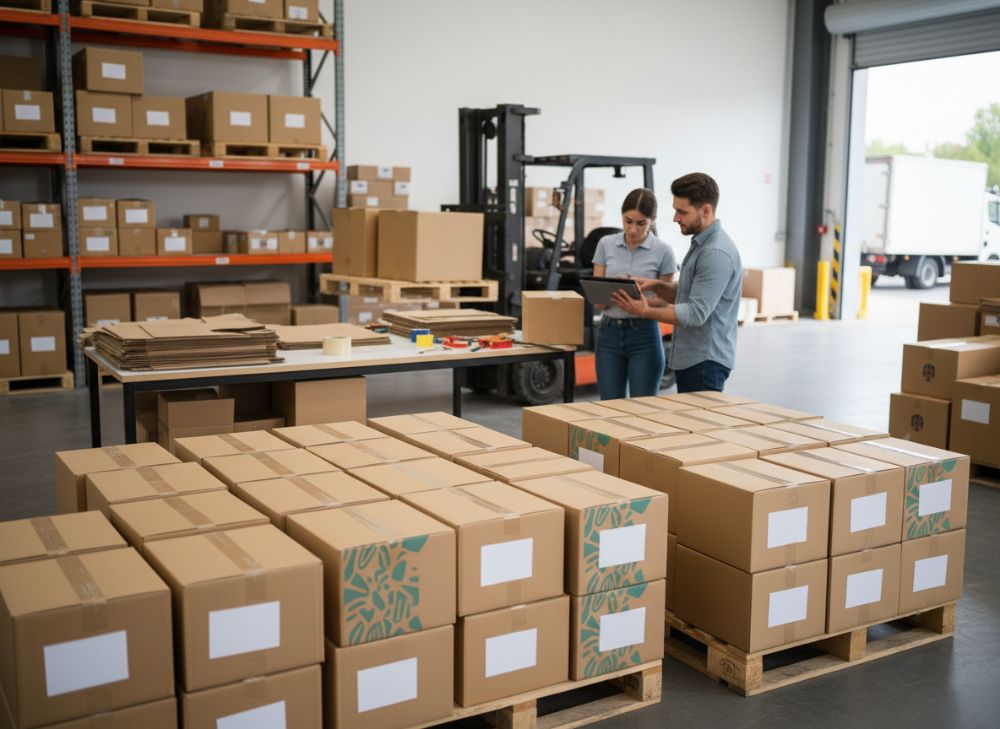
Applying branded labels to stock boxes is one of the most flexible affordable custom packaging options for small businesses. It allows you to buy plain boxes in practical quantities while updating the exterior whenever your campaign, product range or branding changes.
Labels work particularly well for:
- Start-up product launches
- Subscription or repeat-order packaging
- Limited-edition collections
- Seasonal gifting
- Small batches with several product variants
- Businesses testing a new brand identity
Choose the label size based on the available flat area of the box, not simply on the size of your logo. A label that wraps over folds, sits too close to an edge or covers an opening seam may look uneven and can be difficult to apply consistently.
For a polished finish, keep the design clear. A logo, short message and web address or product descriptor are often enough. If the label includes variable information such as flavour, shade or batch details, leave space in the layout for this content rather than trying to fit everything into one crowded design.
Material choice matters too. Paper labels can complement kraft packaging and a natural brand style, while other label materials may suit smooth coated cartons or packaging exposed to more handling. Confirm that the adhesive is suitable for the surface finish and expected storage conditions before committing to a full run.
Explore custom printed stickers when labels are a better match for your order volume, campaign schedule or need for design flexibility.
Finding the Right Supplier: Local vs. Overseas
Choosing between a UK-based supplier and an overseas manufacturer is not solely a question of quoted unit cost. The right choice depends on your order size, timetable, packaging complexity, communication needs and tolerance for risk.
A local supplier may make it easier to discuss samples, resolve artwork questions and replenish packaging in smaller quantities. It can also simplify communication where your team needs close involvement in material, colour or structural decisions.
An overseas supplier may be considered for larger, stable orders, particularly where the structure and specification are already well defined. Yet the total landed cost can be more complex to assess. It may include freight, taxes, clearance-related costs, packing requirements, sampling, payment terms and the financial effect of holding more inventory.
| Consideration | Local supplier may suit you when | Overseas supplier may suit you when |
|---|---|---|
| Order volume | You need smaller or more frequent batches | You have a stable, higher-volume requirement |
| Design stage | Artwork or structure is still evolving | Specifications are final and repeatable |
| Timing | You need greater flexibility for replenishment | You can plan well ahead |
| Communication | You want straightforward review and issue resolution | You have a detailed specification and clear approval process |
| Stock holding | Storage capacity is limited | You can hold a larger delivery safely |
| Total cost | You need a simple view of total purchasing costs | You can evaluate all landed and administrative costs |
Whichever route you choose, provide a written packaging specification. It should cover internal and external dimensions, board or paper type, colour references where relevant, print coverage, finish, assembly method, quantity, packing arrangement and approved artwork version.
Request a physical sample, production proof or other appropriate pre-production approval where available. Digital artwork can help check layout, but it may not show the final feel of a material, the behaviour of a fold or the exact appearance of colour on a chosen substrate.
For packaging that will touch food, cosmetics, children’s products or other regulated goods, verify the relevant UK requirements and the suitability of each packaging component for its intended use. Do not assume that a material or finish suitable for one application is suitable for another.
Simplified One-Colour Printing for Cost Savings
A one-colour design can be highly recognisable when it is planned properly. Reducing the number of print colours can simplify production and keep the packaging focused, especially on uncoated paperboard or kraft stock.
This does not mean your branding has to look plain. Strong contrast, well-chosen typography and sensible use of empty space often create more impact than a complicated multicolour layout.
One-colour printing is particularly effective for:
- Wordmarks and logos
- Repeating patterns
- Product names and key descriptors
- Simple line illustrations
- Short brand messages
- Care, handling or recycling guidance where appropriate
Before choosing one colour, consider the base material. Ink will appear differently on white board, natural kraft paper and coloured stock. A design that looks crisp on a white digital mock-up may appear softer or darker on a textured brown surface.
Avoid very fine reverse text, delicate lines and small gaps if they are likely to lose clarity on a textured material. Ask your supplier for artwork guidance on minimum line weights, text sizes and colour handling. If brand colour consistency is important across labels, cartons and other materials, confirm the practical matching process before production.
A restrained design can also make future changes easier. You may be able to use the same outer box for several product lines and differentiate them with a sticker, sleeve or colour-coded insert.
Using Kraft Paper Boxes for a Trendy, Low-Cost Look
Kraft paper boxes can offer a straightforward, natural-looking packaging style without relying on elaborate print or finishes. They are often a good fit for brands that want a warm, tactile appearance or a simple handmade presentation.
The visual benefit of kraft comes from letting the material remain visible. A black, dark brown, deep green or other high-contrast single-colour design can stand out clearly against the natural background. Pairing the box with a matching paper label, twine or tissue can create a cohesive look without needing extensive decoration.
There are limitations to consider:
- Colour reproduction: Bright and pale colours may not reproduce as expected on a brown base.
- Surface variation: Natural paper can vary in appearance, which may be part of the intended character but is unsuitable for every brand.
- Print detail: Fine photographic imagery and subtle tonal gradients are generally less suitable than bold graphics.
- Product fit: Kraft is an aesthetic choice, not a universal protection solution; choose the board grade and structure according to the product’s weight and handling needs.
- Sustainability claims: Do not make environmental claims simply because packaging looks natural. Confirm the material composition, disposal route and any claims you intend to print.
Kraft works best when the product, brand voice and design style genuinely support it. A luxury skincare range, for example, may need a different surface and finish from a handmade stationery business, even if both want a minimal look.
Design Tips for Minimalist, High-Impact Packaging
Minimalist packaging is a cost-control tool as well as a design approach. By concentrating attention on a few key elements, you can reduce print complexity and avoid spending on features that do not improve the customer experience.
Prioritise one clear message
Decide what customers should notice first: your brand name, the product name or the purpose of the gift. Make that element visually dominant. Everything else should support it.
A useful front-panel hierarchy is:
- Brand or logo
- Product name or collection
- One short differentiating phrase, if needed
- Essential product information elsewhere on the pack
Trying to make every message equally prominent usually makes packaging harder to read.
Use space as part of the design
Empty space does not mean unfinished packaging. It provides contrast, makes a logo easier to notice and can make a standard box feel more considered. Keep margins consistent around text and graphics, particularly near folds, glued seams and opening edges.
Design for the real box, not just the screen
Check where panels fold, where labels are applied and how the box will be held when opened. Important information should not disappear into a crease or sit on a panel likely to be covered by tape, an address label or a security seal.
If you sell several products, build a repeatable design system. Use the same logo position, typography and layout across formats, then change just one element, such as the product name or label colour. Consistency can look more professional than creating a different box design for every item.
Keep finishing purposeful
Foiling, embossing, spot effects and unusual closures can all add visual interest, but each should have a clear role. Ask whether the feature supports the product positioning, opening experience or shelf presentation. If not, use that budget on better structure, clearer printing or a more suitable material.
For box structures and branding options, review the range of custom boxes before finalising artwork. A design should fit the chosen format, rather than forcing a format to accommodate the design.
Negotiating Better Rates on Gift Packaging Accessories
Accessories such as tissue paper, ribbons, sleeves, inserts, seals and hang tags can transform a simple box. They can also increase cost quickly when each component is sourced, printed and handled separately.
The best way to negotiate effectively is to make your requirement clear and repeatable. Suppliers are better able to quote accurately when they know the material, dimensions, print treatment, quantity, packing preference and likely reorder pattern.
Consider these approaches:
- Standardise accessory sizes. One or two tissue sheet sizes or ribbon widths can support several box formats.
- Reduce unnecessary variations. A single branded seal may work across multiple collections.
- Bundle compatible items. Ask whether boxes, inserts and labels can be planned together, while still comparing the total cost with separate sourcing.
- Use neutral base materials. Plain tissue or ribbon can be paired with a branded label for a lower-commitment look.
- Share realistic forecasts. If you expect repeat orders, explain the likely pattern without promising volumes you cannot support.
- Ask about specification alternatives. A different paper weight, print coverage or standard accessory size may reduce cost without changing the overall presentation.
Gift packaging needs to be practical for the person packing orders. Test whether tissue tears easily, whether seals adhere to the chosen surface and whether inserts can be placed quickly. A beautiful accessory that slows packing or requires specialist handling can add hidden operational cost.
For ideas on coordinating boxes, tissue, inserts and finishing details, see gift packaging options.
A Practical Budget Checklist Before You Order
Use this checklist to compare packaging options fairly:
- Is the box size based on the fully packed product?
- Can a standard size replace a bespoke die-cut structure?
- Does the design work in one colour or with a label rather than full-box print?
- Are seasonal messages kept on removable components?
- Have you compared total cost, including setup, storage and accessories?
- Is the material and finish appropriate for handling, product weight and intended use?
- Have you approved artwork with folds, safe areas and openings in mind?
- Have you checked any relevant UK labelling, product-contact and disposal requirements?
- Can the packaging be reused across more than one product line?
- Have you tested the packing process with a physical sample?
Frequently Asked Questions
Is custom packaging worthwhile for a small business?
It can be, provided the level of customisation matches your sales volume and brand needs. A standard box with a well-designed label or insert can look distinctive without the cost and commitment of a fully bespoke printed box.
What is the most affordable way to make plain boxes look branded?
Branded stickers, a simple stamp-style graphic, printed tape, tissue paper or a small insert can add identity to plain boxes. Labels are especially useful when products, campaigns or artwork change frequently.
Should I choose the cheapest packaging quotation?
Not without checking what is included. Compare the full specification, setup charges, material, print process, finishes, packing, quantity, storage implications and any costs associated with getting the packaging to your premises.
How can I avoid ordering too much branded packaging?
Keep permanent branding on the box and put short-term details on labels, sleeves or inserts. This lets you use the same core packaging after a product update, campaign change or seasonal period.
Affordable packaging is usually the result of disciplined choices rather than cutting every feature. Start with a robust standard box, specify only the custom details that strengthen your brand and test the complete packing process before scaling up. If you are comparing suppliers, XGolden Print’s company background notes its experience in custom packaging and printing, which may help you frame questions about capability and specification.