
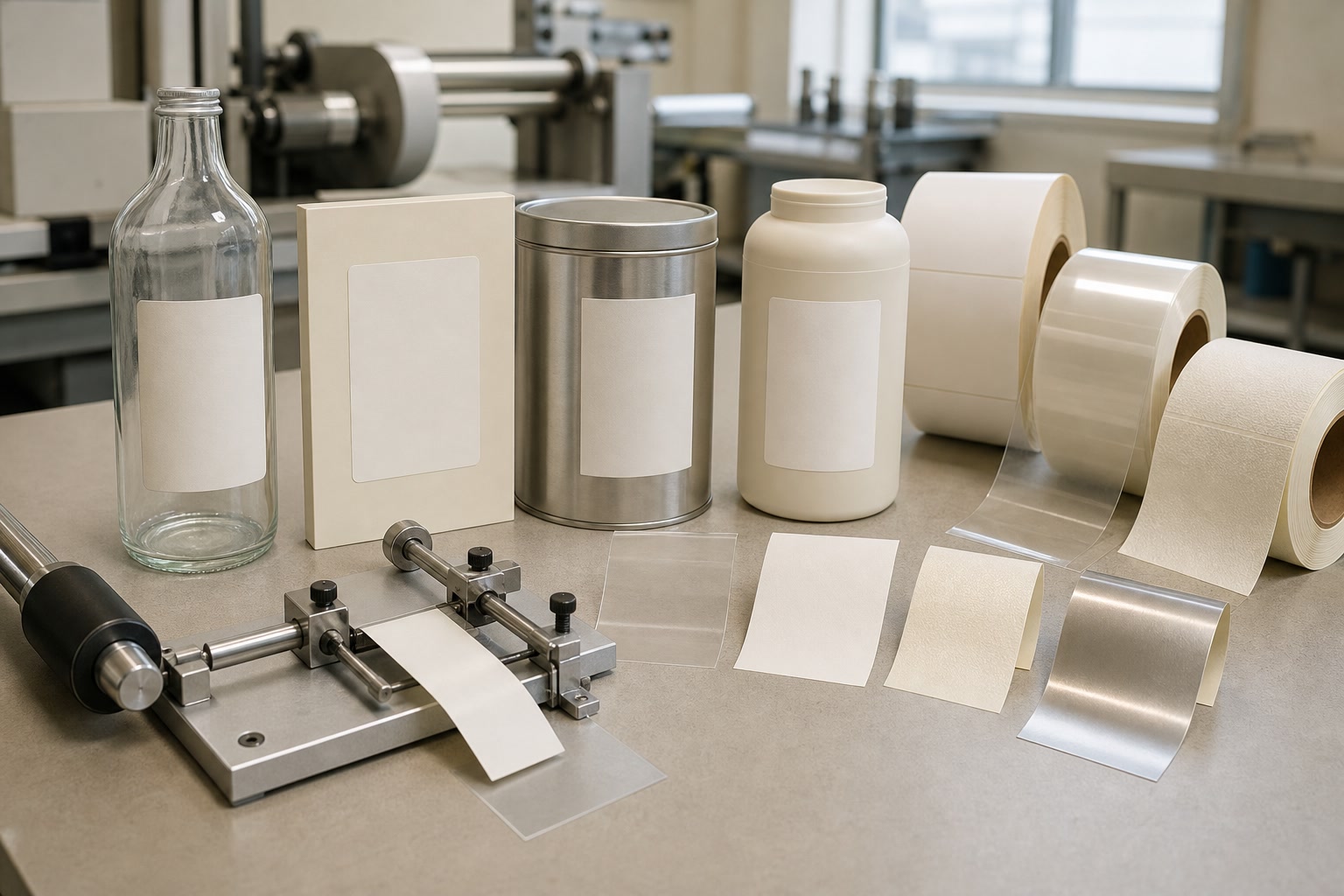
The best approach to label adhesive selection is to start with the real application surface, not the label’s appearance. A label that sticks well to clean glass may lift from a textured carton, a low-energy plastic bottle or a chilled container because each material, finish and environment presents a different bonding challenge.
Identify the substrate, consider its shape and exposure conditions, then decide whether the label must stay permanently attached or remove cleanly. Finally, test the finished label on the actual pack over time. The adhesive, face material, liner and label shape work as one construction, so choosing an adhesive alone is rarely enough.
Identify the substrate and surface finish
A substrate is the material receiving the label. It may be glass, aluminium, steel, paperboard, corrugated board, polyethylene, polypropylene, PET, PVC, wood or a coated composite. Two packs that look similar can have very different surfaces, so specify the exact material rather than simply saying “plastic” or “card”.
The most important property is surface energy: how readily a surface allows an adhesive to spread and make contact.
- High-surface-energy materials include glass, clean metal and many paper surfaces. Standard permanent adhesives often bond effectively to these.
- Low-surface-energy materials include polyethylene (PE), polypropylene (PP) and some treated or waxy surfaces. They can require an adhesive formulated specifically for low-energy plastics.
- Variable surfaces include recycled board, coated card, lacquered packs and moulded plastics. Their performance may vary by supplier, coating batch or manufacturing treatment.
An adhesive needs intimate contact with the substrate. If it cannot wet out across the surface, the bond may initially seem adequate but fail at corners, edges or seams.
Check the finish, not just the base material
The surface finish frequently changes the adhesive requirement more than the base substrate does. Ask the packaging supplier whether the label will be applied to any of the following:
- Gloss or matt varnish
- Soft-touch coating
- Aqueous or UV coating
- Lamination film
- Silicone, wax or release treatment
- Powder-coated metal
- Textured, embossed or uncoated board
- Recycled or fibrous paper stock
- Plastic mould-release residues
- Oil, dust, flour, grease or other production contamination
For example, a permanent label on untreated folding box board may adhere very well, while exactly the same adhesive can struggle on a heavily varnished carton. Similarly, an adhesive designed for glass jars may not hold reliably on an HDPE cosmetic bottle.
Surface condition matters at the point of application
Even a suitable adhesive can fail when the pack is dirty, wet, cold or recently treated. Before approving a label, identify whether the pack is:
- Clean and dry when labelled.
- Labelled shortly after filling, coating or moulding.
- Exposed to dust, condensation or product splash on the packing line.
- Stored or transported in a way that transfers oil, moisture or abrasion to the label.
Where a process leaves residues, improving pack preparation may be as important as changing adhesive. Do not assume a stronger adhesive will overcome a layer of water, oil or silicone.
Review flat, curved and tapered geometry
Label adhesive selection must account for pack geometry because curves and tapers create lifting forces that are absent on a flat panel. A label can have excellent adhesive performance in a flat sample test but fail when wrapped around a small bottle, tube or jar.
Flat panels offer the broadest adhesive choice
Flat cartons, envelopes, boxes and rigid boards are usually the simplest applications. The label can sit without tension, enabling consistent contact across its full area.
However, flat does not automatically mean easy. Rough corrugated board, fibres lifting from uncoated card or deep texture can reduce actual contact area. In such cases, an adhesive with good initial tack and conformability may perform better than one intended only for smooth surfaces.
For branded packaging, ensure the adhesive does not damage the printed or coated carton surface if the label might need to be removed during rework.
Curved containers need flexible conformity
Cylindrical jars, bottles, tins and tubes create a tendency for the label’s outer edges to pull away. The smaller the diameter, the more important the label construction becomes.
Consider:
- Label size: A wide label resists bending more than a narrow one.
- Face stock stiffness: Thick paper or rigid film may tent at the edges on tight curves.
- Adhesive tack: Sufficient initial tack helps establish contact before the container is handled.
- Application pressure: Label applicators must apply enough pressure for the adhesive to wet out.
- Overlap and seam placement: Labels should not be forced across raised seams, mould lines or sharp changes in contour.
A clear film label on a curved bottle can show lifting more obviously than a paper label. This is not simply cosmetic: lifted edges collect dirt, snag during handling and may progress into full label failure.
Tapered shapes are a common source of edge lift
Tapered tubs, conical jars, cups and some cosmetic containers are more challenging because the top and bottom diameters differ. A rectangular label naturally tries to bridge or wrinkle when wrapped around a taper.
Possible ways to improve performance include:
- Use a label shape designed for the container’s taper.
- Reduce label width where practical.
- Choose a more conformable face material.
- Avoid placing critical label edges across highly tapered areas.
- Use an adhesive that has been tested on the actual container.
- Consider whether a sleeve, direct print or alternative decoration method is more appropriate.
Do not correct a geometry issue solely by selecting a more aggressive adhesive. A stronger adhesive can make removal harder without preventing the face stock from pulling against the container shape.
Define temperature, moisture and handling exposure
Adhesives are affected by the temperature at which a label is applied and by the temperatures it experiences afterwards. These are separate requirements.
A label might be applied in a warm packing area but later stored in a refrigerator. Alternatively, a product may be labelled while cold, which is more demanding because many pressure-sensitive adhesives develop bond strength slowly at low temperatures.
Specify application temperature and service temperature separately
When discussing label adhesive selection with a printer or converter, provide both figures:
- Application temperature: the surface temperature when the label is applied.
- Service temperature: the range the labelled product experiences during storage, distribution and use.
Also mention any sudden changes, such as moving products from ambient packing into chilled storage or from cold storage to a warm, humid retail environment.
Common scenarios include:
| Application scenario | Adhesive risk | What to confirm |
|---|---|---|
| Ambient dry goods | General lifting or carton fibre damage | Adhesion to the exact board and coating |
| Chilled food or drink | Poor initial bond, condensation | Minimum application temperature and moisture tolerance |
| Freezer storage | Brittle adhesive performance or edge lift | Low-temperature service suitability |
| Hot-filled products | Adhesive softening or movement | Maximum short-term and long-term exposure |
| Bathroom or kitchen products | Water, steam, oils and cleaning products | Resistance to expected splashes and handling |
| Outdoor packs or equipment | UV, rain, temperature cycling and abrasion | Full construction durability, not adhesive alone |
Moisture and condensation need realistic testing
Water is one of the most common reasons labels fail. Condensation can form after a chilled product enters a warmer room, even when the container looked dry at the time of labelling. A label applied to a wet surface may appear secure initially but peel within hours.
Consider whether labels will encounter:
- Condensation on cold bottles, jars or tubs
- Refrigeration and freezer conditions
- Water splash during filling or cleaning
- Humidity in storage
- Repeated use in wet rooms
- Finger oils, creams or food residues
- Rain or outdoor storage
For chilled applications, test the label after a full condensation cycle rather than checking it only straight after application. Also inspect corners and the leading edge, where failure normally begins.
Handling creates abrasion and peel forces
Handling exposure includes more than transport. Labels may rub against other packs, conveyor guides, shelves, bags, hands, moisture and cleaning materials. A label on a refill pouch, for example, flexes repeatedly; one on a gift box may be subject to scuffing but little moisture.
The face material and protective finish affect scuff resistance, while the adhesive affects edge security. Evaluate them together. A durable laminate does not compensate for an adhesive that lifts, and an excellent adhesive does not protect print from abrasion.
Choose permanent, removable or repositionable behaviour
The right bond is defined by what must happen at the end of the label’s useful life. “Permanent” does not mean indestructible, and “removable” does not mean it will peel cleanly from every surface after every exposure. Both depend on substrate, time, temperature and conditions.
Permanent adhesive: for labels intended to stay in place
Permanent adhesives are appropriate where the label must remain attached through normal distribution, retail handling and product use. They are commonly used for product identification, branding, ingredient labels, shipping labels and information labels.
A permanent bond should be selected where:
- The label is not intended to be removed by the customer.
- The pack may be chilled, handled often or exposed to moisture.
- Edge lift would create a quality or operational issue.
- The label needs reliable long-term attachment to a known substrate.
There are different types of permanent adhesive. A general-purpose permanent adhesive may suit smooth card or glass, while an all-temperature, high-tack or low-surface-energy option may be needed for more demanding applications. Confirm the intended substrate instead of assuming any permanent adhesive is suitable.
Removable adhesive: for clean temporary labelling
Removable labels are designed to peel away with limited residue and minimal surface damage during a stated use period. They can suit promotional stickers, temporary price labels, warehouse identification, sample labels and reusable containers.
The main risks are:
- Residue after prolonged dwell time.
- Adhesive transfer in heat or direct sunlight.
- Reduced removability on porous paper or uncoated board.
- Labels falling off too easily in cold, damp or high-handling settings.
- Damage to coatings or printed surfaces during removal.
If clean removal is essential, test it at the latest realistic removal point, not merely the day of application. A label that removes cleanly after one hour may leave residue after several months or after temperature cycling.
Repositionable adhesive: for adjustment during application
Repositionable adhesives allow a label to be lifted and adjusted shortly after application. They are useful when accurate placement matters, such as on premium presentation boxes, short-run packs or manually applied labels.
Repositionability is usually a short-term property. It should not be confused with long-term removability. Some labels can be repositioned during application but develop a stronger bond over time. Define how long adjustment is needed and whether the finished label must later remove cleanly.
Match adhesive behaviour to the customer journey
Ask these practical questions:
- Does the label need to remain attached for the life of the product?
- Will warehouse staff remove it before retail sale?
- Is the customer expected to peel it off?
- Does removal need to leave the pack pristine for reuse or gifting?
- Will a removed label reveal price, batch or operational information that must not be visible?
- Is the surface itself likely to tear, delaminate or lose print during removal?
For reusable glass jars or metal tins, clean removability may support reuse. For labels applied to gift packaging, a repositionable adhesive can reduce placement errors. For transport identification, a permanent adhesive may be required during distribution but could be unsuitable if it damages the retail pack on removal.
Test ageing, edges and residue
A short adhesion check is useful, but it is not an approval process. Pressure-sensitive adhesives often build bond strength over time, while environmental exposure can reveal failures that are not visible immediately.
Test with production-representative labels, actual packaging and normal application equipment wherever possible.
Build a simple but useful test plan
A practical evaluation can include the following steps:
- Apply samples at the normal line speed and pressure. Manual samples can be useful, but they may not reflect machine application.
- Inspect immediately. Check for bubbles, wrinkles, tunnelling, poor wrap and visible lifting.
- Allow dwell time. Review after 24 hours, then at the expected interval for use or distribution.
- Expose samples to realistic conditions. This might include cold storage, humidity, heat, handling, packing and transit simulation.
- Check all edges and corners. Pay particular attention to the leading edge, curved areas and points near seams.
- Assess removal. Where relevant, remove labels at several time points and inspect for residue, fibre tear, coating damage or adhesive transfer.
- Record the variables. Note substrate batch, label version, application temperature, dwell time and conditions.
What good and poor results look like
A satisfactory permanent label should remain flat with secure edges and no excessive ooze, movement or wrinkling. A satisfactory removable label should detach in the intended time window without objectionable residue or damage to the pack.
Common warning signs include:
- Corners beginning to curl.
- Lifting near a shoulder, seam or taper.
- Adhesive visible beyond the label edge.
- Air channels beneath clear film.
- Label shrinkage or face-stock distortion.
- Paper fibres tearing away with a removable label.
- Coating or print lifting off a carton.
- A clean peel at first, followed by residue after ageing.
Do not overlook visual inspection. Minor edge lift can become a significant issue once labels rub against cases, shelves or other packs.
Test the worst credible condition
It is rarely enough to test only a clean, room-temperature, dry pack. Select the most difficult plausible condition: the coldest application point, the most textured carton, the lowest-energy plastic, the longest expected storage period or the wettest handling stage.
If materials or suppliers change, repeat the relevant test. A change in carton varnish, plastic resin, label face film or packing process can affect results even if the adhesive specification remains unchanged.
Approve the complete label construction
The final approval should cover the complete label construction rather than a generic adhesive description. A finished label consists of the face material, print, inks, varnish or laminate, adhesive, liner, die-cut shape and application method. Each can influence performance.
For example:
- A rigid face material may lift from a curved container despite a suitable adhesive.
- A label with sharp square corners may be more prone to catching than one with rounded corners.
- Heavy ink coverage or a thick finish can alter flexibility.
- A different liner can affect dispensing performance on automatic labelling equipment.
- A label applied with insufficient pressure may underperform even when the material is correctly specified.
Approval checklist for packaging buyers
Before approving production, document the following:
- Exact substrate material, grade and surface finish
- Container or pack geometry, including taper and seams
- Label dimensions, corner shape and orientation
- Face stock, finish and print coverage
- Adhesive type and intended behaviour
- Application method, pressure and approximate surface temperature
- Storage, transit and use conditions
- Required service life
- Removal expectations and acceptable residue level
- Results from representative samples and ageing checks
Where labels are part of a regulated product pack, ensure the final construction also supports legibility and durability of mandatory information under the conditions it will face. The appropriate requirements vary by product category, so this should be reviewed separately from adhesive performance.
For a packaging project involving branded seals, carton labels or product stickers, review the available custom sticker options alongside the target substrate. The most attractive finish is only effective when it remains properly attached for the intended use.
Common label adhesive selection mistakes
Avoid these frequent specification errors:
- Selecting by “permanent” or “removable” alone without naming the substrate.
- Treating all plastics as equivalent.
- Testing a flat sample when the production pack is curved or tapered.
- Ignoring the application temperature because the final storage temperature seems acceptable.
- Applying labels over moisture, mould-release residue, dust or oil.
- Assuming an adhesive will solve a stiff face-stock or unsuitable label-shape problem.
- Testing removal only immediately after application.
- Approving samples made by hand but not checking automatic application.
- Forgetting that a coating, varnish or new packaging supplier changes the surface.
FAQ
Which adhesive works best on plastic bottles?
There is no single best option. PET, HDPE, PP and PE bottles have different surface energies, and bottle shape, temperature and moisture exposure also matter. Low-surface-energy plastics such as PE and PP often need an adhesive designed for that substrate. Test on the exact bottle, including any mould lines, texture or decoration.
Can a permanent label be removed without residue?
Sometimes, but it should not be assumed. Residue depends on adhesive chemistry, substrate, storage time, temperature and removal speed. If clean removal is a requirement, specify a removable adhesive and conduct dwell-time tests on the finished pack.
Why do labels peel from chilled bottles?
The likely causes are application onto a cold or damp surface, condensation, insufficient application pressure, an adhesive not suited to low temperatures, or a stiff label construction on a curved bottle. Review both application conditions and subsequent refrigerated exposure.
Does a stronger adhesive always prevent edge lift?
No. Edge lift can be caused by tight curvature, taper, poor label shape, stiff face material, surface contamination or inadequate application pressure. A more aggressive adhesive may introduce residue or carton damage without resolving the underlying mechanical issue.
A sound label adhesive selection process starts with the actual pack and finishes with a realistic test, not a catalogue description. Provide the substrate, surface finish, geometry, application temperature, exposure conditions and removal requirement when requesting samples, then approve the complete construction only after it has performed on the intended packaging.