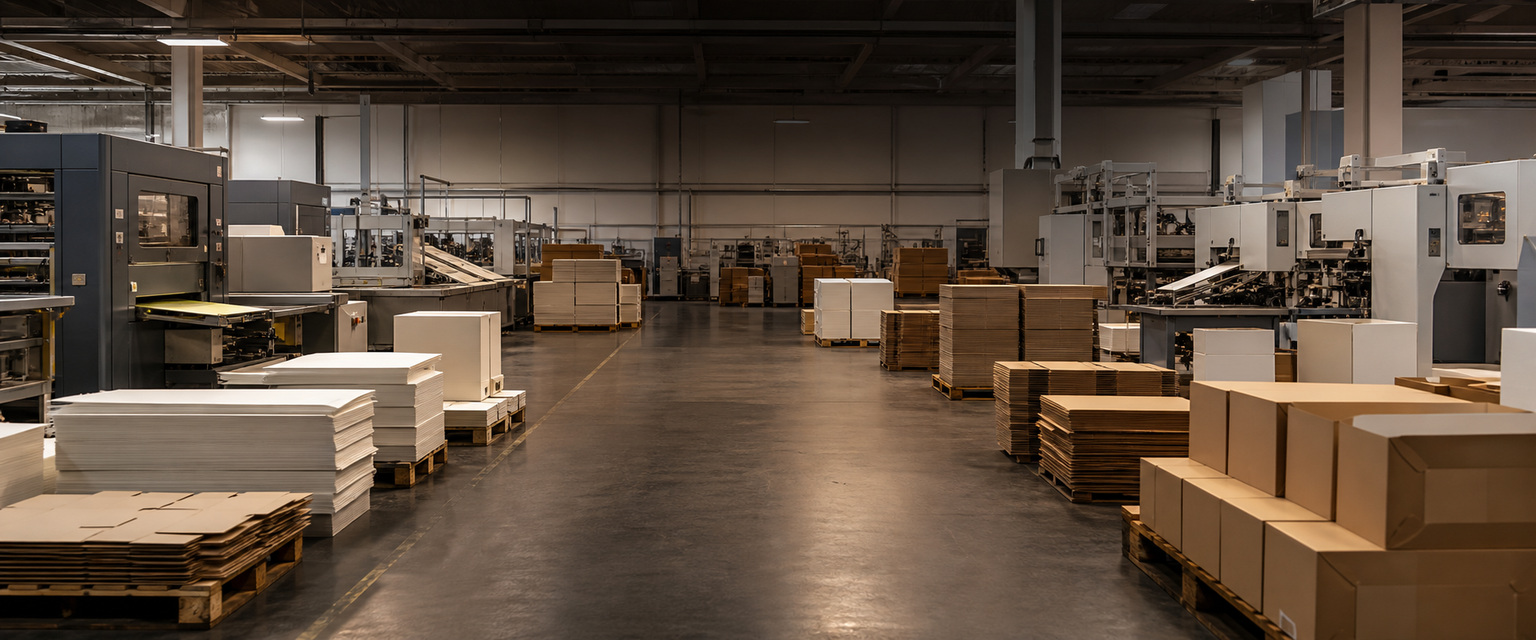
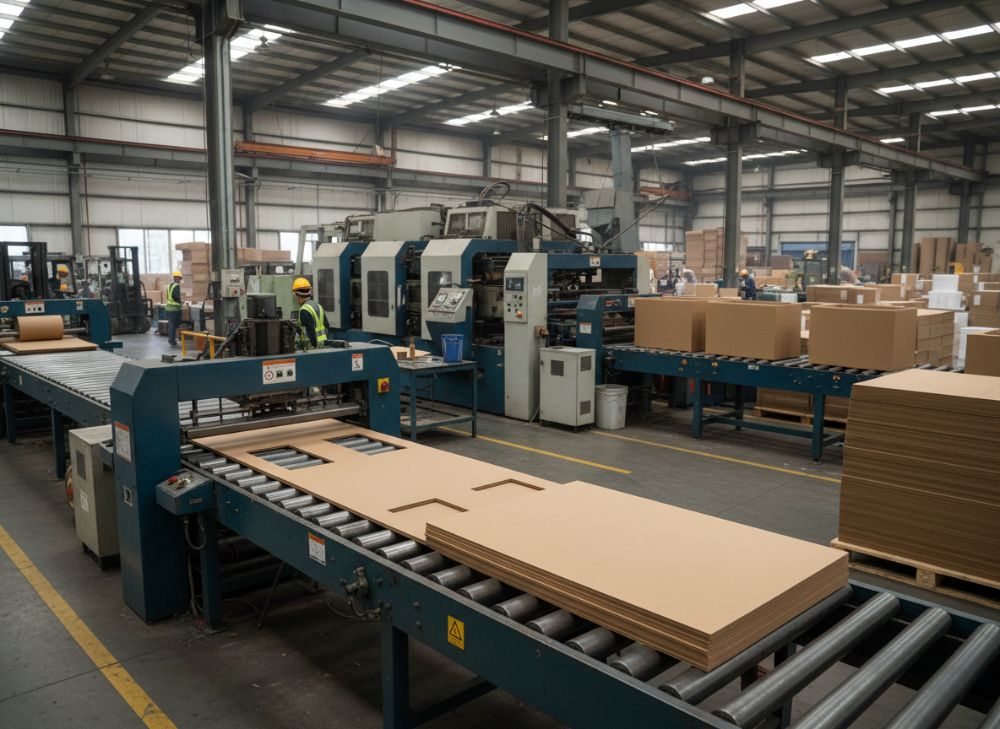
Custom paper boxes are made by converting flat paperboard or corrugated board into accurately cut, printed and folded packaging. The core sequence is straightforward: select the board, prepare the artwork, print the sheets, die-cut and crease them, add any finish, glue or assemble the box, then inspect and pack the finished units.
In practice, the details make the difference. Box style, product weight, print design, finish, assembly method and transport conditions all affect the specification. Understanding the process helps UK buyers compare quotations on more than appearance and avoid costly changes after production has begun.
The Paperboard Manufacturing Process
A packaging supplier may purchase paperboard as sheets or reels and convert it into boxes, rather than manufacture the fibre-based board itself. For a buyer, the important question is which board construction is appropriate for the product and the intended retail or e-commerce journey.
Common materials include:
- Folding boxboard: a smooth paperboard often chosen for lightweight retail cartons, cosmetics, food-adjacent packaging where suitability has been confirmed, and promotional boxes.
- Solid bleached or unbleached board: board options selected where a clean appearance, stiffness or a particular natural finish is required.
- Duplex board: a layered board with different surfaces, often specified for printed cartons where the outer face is the priority.
- Corrugated board: a fluted inner layer between liners, used where greater cushioning and stacking resistance are needed.
- Rigid board: dense greyboard or similar substrate wrapped with printed paper, commonly used for premium presentation boxes.
Material choice should start with the product, not the artwork. A delicate item may need a stronger outer box or an internal fitment. A lightweight item may only need a folding carton, provided it will not be used as its primary shipping pack.
What happens before printing
Before press work begins, the paperboard specification and artwork are checked. This stage commonly includes:
- Confirming dimensions — internal dimensions must accommodate the product, any tissue, inserts and normal production tolerances.
- Selecting grain direction — paper fibres tend to align in one direction. Folding against or with the grain can affect crease quality, panel flatness and the way a box opens.
- Creating a dieline — the structural drawing defines cut lines, crease lines, glue areas, windows and fold sequence.
- Reviewing artwork — text, barcodes, colour, bleed, safe areas and image resolution are assessed against the dieline.
- Making a proof or approval sample where appropriate — this helps identify layout or structural issues before volume production.
A frequent mistake is to specify only length, width and height. State whether these are internal or external measurements, identify the product’s true packed dimensions, and include any insert, sleeve or closure requirements.
For standard folding cartons and tailored formats alike, the design begins with the board and structure. Explore custom packaging boxes when comparing box styles and printed carton options.
The Die-Cutting and Creasing Phase
Die-cutting turns a printed sheet into a box blank. A cutting forme contains shaped rules that cut the outer profile, while separate rules score crease lines. The blank is then ready for folding, gluing or manual assembly.
The die-cutting and creasing phase determines whether the box folds cleanly and presents well on shelf. A design can look correct on screen yet perform poorly if its creases crack, its tabs are too small, or its locking features do not engage consistently.
What a dieline controls
A well-prepared dieline typically sets out:
- Cut edges and waste areas
- Fold and crease lines
- Glue flaps and no-print zones
- Locking tabs, tuck ends or tear features
- Window apertures
- Hang tabs, where required
- Positions for embossing, foil or other finishing
- Orientation of the printed artwork
Die-cut tools are particularly useful where a box has an irregular silhouette, a shaped window or repeated structural features. Simpler rectangular cartons may still need a bespoke forme because crease positions, flap lengths and glue areas must match the selected board.
Design points to check before tooling
Ask to review the flat dieline and, where needed, an assembled plain sample. Check the following:
- Does the product fit with sensible clearance, rather than rattling or forcing the panels apart?
- Can the user open and reclose the box as intended?
- Are glue flaps large enough for a dependable bond?
- Will metallic finishes, dense ink coverage or coatings sit across fold lines?
- Is the board thickness suitable for small locks and tight folds?
- If a window is used, is the film, attachment method and recycling route appropriate for the packaging objective?
Changing the structure after a cutting forme has been prepared can introduce additional work and delay. Freeze dimensions, closure style and insert requirements before authorising production tooling.
Printing and Finishing Techniques
Printing gives a custom box its visual identity, while finishing changes its surface feel, contrast and perceived quality. Neither should be specified in isolation: the printing method and finish need to suit the board, artwork, order quantity and physical handling expected.
Common printing approaches
| Method | Best suited to | Considerations for buyers |
|---|---|---|
| Digital printing | Shorter runs, variable designs and projects needing flexible artwork changes | Confirm colour expectations, substrate compatibility and the finish available for the chosen process. |
| Offset lithographic printing | Detailed artwork, consistent repeat production and larger printed-sheet runs | It commonly involves more set-up planning; approve the artwork and colour references carefully. |
| Flexographic printing | Some corrugated packaging and simpler graphic applications | Fine detail and colour appearance depend on the substrate, plate preparation and design. |
| Screen printing | Selected special effects, bold areas or particular materials | It can be useful for specific finishes, but is not automatically the right choice for every full-colour design. |
There is no universally “best” print method. A digitally printed short run may be more practical for a launch, whereas an offset approach may suit a stable design being produced repeatedly. Request clarity on the method proposed and ensure any physical sample reflects the intended board and finish where possible.
Surface finishes and decorative effects
Popular finishing options include:
- Matt or gloss lamination for a protective film-like surface and a distinct visual effect.
- Aqueous or varnish coatings to alter sheen and offer surface protection.
- Spot UV to add gloss contrast to selected artwork elements.
- Foil stamping for metallic accents.
- Embossing or debossing to create raised or recessed details.
- Soft-touch coatings for a velvety tactile effect.
- Die-cut windows to show the product or an internal layer.
Finishes can bring trade-offs. Heavy ink coverage may show scuffing more readily than a lighter design. Foil, laminates and multi-material windows can affect the packaging’s end-of-life options. Raised or coated areas may be unsuitable for barcode scanning if they obscure contrast or distort the printed code.
If recyclability is a priority, discuss the full material build rather than relying on the word “paper” alone. Confirm the board, coatings, films, adhesives, inks and local collection considerations relevant to the packaging’s target market.
Automatic Gluing and Folding Machines
For many carton formats, production blanks move through automatic folding and gluing equipment. The machine applies adhesive to designated flaps, folds the carton into its delivery shape and holds it long enough for the bond to develop before packing.
This process is commonly suited to cartons such as straight-line boxes, crash-lock bases and some multi-point glued designs. It can improve repeatability for a design that has been engineered for machine folding, but it is not suitable for every box.
When automatic folding is a good fit
Automatic folding and gluing is usually worth considering when the design:
- Has repeatable folds and accessible glue flaps
- Can be supplied flat-packed after gluing
- Does not require hand-applied decorative components
- Uses a structure proven to travel and open properly
- Has a run size and production plan that justify set-up
Some features add complexity: unusually thick board, small locking tabs, magnets, ribbon, fitted trays, layered sleeves and delicate decorative elements. These may require slower production, hand finishing or a different construction.
A useful procurement question is: Will the box arrive flat and need assembly, or will it arrive pre-glued and ready to erect? The answer affects packing speed, storage volume, fulfilment labour and the risk of incorrect assembly.
Manual Assembly for Complex Gift Boxes
Complex gift packaging often involves manual assembly because it combines materials or features that cannot be handled entirely by an automatic folder-gluer. Rigid set-up boxes, magnetic closures, ribbon pulls, wrapped lids, shoulder-and-neck boxes and presentation trays are typical examples.
Manual work can include wrapping printed paper around rigid board, applying magnets or ribbons, assembling separate components, inserting trays and checking alignment. It is not inherently better than automated production; it is simply appropriate for structures that need careful component handling.
Specify the experience, not just the style
A “gift box” can mean anything from a simple folding carton to a multi-piece rigid presentation pack. To obtain comparable proposals, describe:
- The product and its dimensions
- Whether the box must be flat-packed or delivered assembled
- Lid type, closure method and opening experience
- Internal tray, divider, tissue or card insert requirements
- Desired finish and any decorative additions
- Whether the box will be displayed, posted, carried or all three
- Expected handling by staff and end users
For premium formats, a physical structural sample is particularly valuable. It allows buyers to assess opening resistance, lid fit, alignment, edge wrapping and how the product sits inside. See gift packaging options for ideas on presentation-led formats and components.
Quality Checks and Inspection Points
Quality checks should happen throughout production, not only when cartons are packed. The exact inspection plan varies by product, but buyers can ask what will be checked at key stages and what approval point applies before a full run proceeds.
Typical inspection points include:
Incoming material review
The board and other components are checked against the agreed specification. Relevant considerations include material type, thickness or caliper, surface condition, colour variation and visible damage. Requirements should be realistic: paper-based materials naturally have variation, especially where uncoated or natural-looking stock is selected.
Pre-production artwork and colour review
Before printing, verify version control, legal or product information supplied by the brand, barcode placement and image quality. If colour is critical, provide agreed colour references and clarify what level of variation is acceptable. Screen colours should not be treated as a reliable final print reference.
In-process structural checks
During cutting, creasing and gluing, checks may cover:
- Cut registration and clean edges
- Crease placement and fold quality
- Cracking or fibre disturbance on folds
- Glue position and bond formation
- Carton squareness and dimensional consistency
- Locking, tuck or closure operation
- Correct orientation of printed panels
Finished-pack checks
Finished boxes should be assessed in the way they will actually be used. Place the product inside, close the carton, check shelf presentation and test whether the design survives ordinary handling. For packaging that will be mailed, test the completed pack with its intended protective materials and outer shipper rather than judging the presentation box alone.
Compliance requirements depend on the product, claims, material contact and sales channel. If your packaging carries mandatory information, safety messaging, recycling statements or barcodes, verify the applicable UK requirements independently and make sure they are included in the final approved artwork.
Global Sourcing and Logistics Challenges
Custom packaging can be sourced locally or internationally, and each approach has practical trade-offs. The appropriate choice depends on project timing, order pattern, storage capacity, risk tolerance, design complexity and total landed cost—not merely unit price.
Challenges to plan for
Longer planning windows: International supply chains may involve additional production scheduling, documentation, freight stages and customs processes. Build contingency into launch planning rather than assuming a box can be reordered at short notice.
Freight volume: Packaging is often light but bulky. A large carton can occupy substantial space even before it is packed with product. Flat-packed designs may reduce storage and transport volume, but they introduce assembly work later.
Damage in transit: Unpacked or poorly protected carton bundles can be crushed, scuffed or exposed to moisture. Define pack-out expectations, outer-carton strength, palletisation where relevant and handling marks appropriate to the product.
Version control: If packaging artwork changes frequently, holding large quantities can create obsolete stock. Shorter runs or staged releases may be more suitable for evolving product information, seasonal campaigns or multiple variants.
Communication across specifications: A quotation is only as reliable as the brief. Use a clear specification covering dimensions, board, print, finish, box construction, quantity, packing method, inspection criteria and delivery terms.
A practical sourcing comparison
| Factor | Local or nearer supply | International supply |
|---|---|---|
| Lead-time visibility | May involve fewer transport stages | Requires more allowance for freight and border processes |
| Sampling and approvals | Physical review may be easier to coordinate | Needs disciplined approval and sample planning |
| Storage pressure | Smaller, more frequent releases may be possible | Larger consolidated orders may increase stockholding |
| Unit-cost focus | May suit lower-volume or responsive requirements | Can be considered for stable, well-planned volume programmes |
| Main buyer priority | Flexibility and coordination | Specification control and total landed-cost planning |
Neither route removes the need for careful specification. Confirm who is responsible for freight, customs documentation, duties where applicable, insurance, delivery appointment requirements and damage claims before placing an order.
Innovation in Paper Box Production Technology
Innovation in paper box production is mainly about improving design flexibility, reducing avoidable waste and making production information easier to control. The value of a new process depends on the packaging objective; a technical feature should solve a defined problem rather than add complexity for its own sake.
Areas buyers may encounter
Digital workflow and proofing: Better file management, dieline control and digital proof processes can reduce artwork-version mistakes. They do not eliminate the need to check copy, dimensions and product fit.
Short-run digital printing: This can support smaller campaigns, regional variants or packaging with changing information. Confirm whether colour, finishing and board choices meet the required presentation standard.
Automated inspection: Camera-based systems and process controls may be used to identify certain print or assembly defects. Ask which checks apply to your project rather than assuming every fault type is covered.
Material reduction: Structural redesign can sometimes reduce board use or eliminate unnecessary layers. Any reduction must be tested against product protection, stacking, opening and retail presentation needs.
Mono-material thinking: Simplifying a packaging build may improve material separation and make disposal instructions clearer. However, performance should be reviewed carefully when removing coatings, windows, foam or other components.
Smarter traceability features: Variable codes, QR codes and batch information can be incorporated into artwork where appropriate. Ensure the code has sufficient contrast, quiet space and a suitable position away from folds, seams and high-gloss effects.
A buyer’s checklist before approving custom boxes
Before moving from concept to production, make sure the following decisions are recorded:
- Product dimensions, weight and fragility
- Internal versus external box dimensions
- Board type, thickness and surface preference
- Box style, closure and whether it must be flat-packed
- Artwork files, dieline version and print method
- Colour references and approval process
- Required finishes, windows or decorative features
- Insert, divider or label requirements
- Barcode, product information and market-specific compliance checks
- Quantity, pack-out method and storage constraints
- Transport route and whether the packaging is a retail pack, shipping pack or both
- Inspection points and acceptable criteria for the finished product
Labels can be a practical alternative to printing every changing detail directly onto a carton. For variant names, batch references or promotional additions, consider how custom printed stickers could fit into the pack design without obscuring essential information.
Frequently asked questions
Is a paper box always recyclable?
No. Recyclability depends on the complete construction and the collection systems available where the packaging is discarded. Coatings, laminates, windows, adhesives, foil and attached components can all affect the outcome. Review the full material specification and verify any environmental claim before using it on-pack.
What is the difference between a folding carton and a rigid box?
A folding carton is typically die-cut from paperboard, creased, glued and supplied flat or partially erected. A rigid box uses thicker board and is commonly wrapped with printed paper or another covering material. Rigid boxes usually provide a more substantial presentation but require more material, space and assembly.
Do I need a sample before ordering?
A sample is strongly advisable when the structure is new, the fit is tight, the finish is important or the product is fragile. At minimum, review a plain structural sample; for appearance-critical work, assess a sample that represents the intended print and finishing approach as closely as possible.
Can one box work for both retail display and posting?
Sometimes, but not always. A presentation carton may need an additional outer shipping pack to protect it in transit. Combining both functions can simplify fulfilment, yet it may require compromises in appearance, material use or opening experience. Assess the completed pack against its full journey.
A well-specified box is easier to manufacture, inspect, pack and replenish. Start by defining the product journey and the non-negotiable features, then compare proposed structures, materials and finishing choices against that brief. For background on XGolden Print’s packaging capability and scale, visit the company overview.