
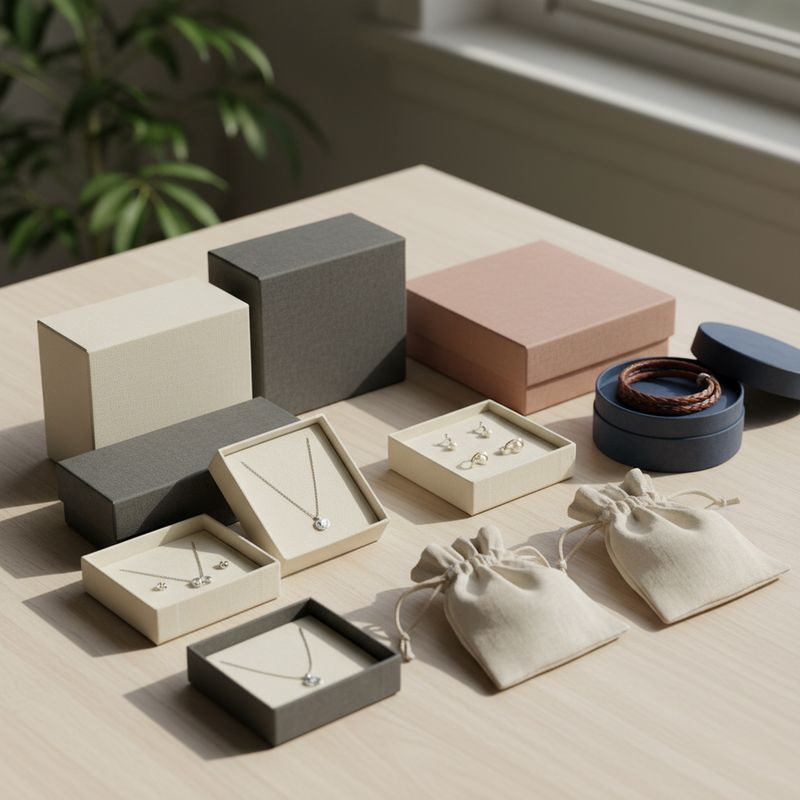
Custom packaging for fashion accessories and jewellery should protect the item, suit its perceived value and make every stage of the customer experience feel considered. The right format depends on the product’s fragility, dimensions, selling channel and whether the packaging must also work as a gift box, retail display or postal pack.
Start by defining what the packaging needs to do before choosing finishes or artwork. A delicate necklace requires different protection from a scarf, hair accessory or pair of sunglasses; likewise, a boutique counter display has different needs from an e-commerce order. Good packaging aligns the product, unboxing experience, storage requirements and brand budget rather than relying on decoration alone.
Accessory Packaging
Fashion accessories cover a broad range of products, so a single box style rarely works for every collection. Begin with the item’s shape, weight, surface sensitivity and the way it will be sold.
For most ranges, custom packaging for fashion accessories and jewellery falls into three practical roles:
- Primary packaging: the box, pouch, card or wrap that directly holds the item.
- Protective transit packaging: an outer postal carton or mailer that protects the primary pack in delivery.
- Retail presentation packaging: packaging designed to be seen on a shelf, counter, display stand or gift table.
Separating these roles can prevent common problems. For example, a rigid jewellery box may provide an excellent gifting experience but still need an appropriately sized outer carton for posting. Asking the presentation box to withstand every handling stage can add unnecessary material and cost.
Match the pack to the product
The internal fit is often more important than the outer appearance. Too much open space allows jewellery or accessories to move, tangle or rub against the box. An overly tight fit, meanwhile, can make the product difficult to remove or damage delicate components.
Consider these commonly used formats:
| Product type | Suitable packaging options | Important design considerations |
|---|---|---|
| Rings, earrings and charms | Small rigid boxes, folding cartons, padded cases | Secure insert, small footprint, easy opening |
| Necklaces and bracelets | Rigid boxes, drawer boxes, flat gift boxes | Prevent tangling; use slots, tabs or a fitted card |
| Watches | Rigid two-piece boxes, hinged boxes, protective cases | Product weight, cushion support and lid stability |
| Sunglasses | Folding cartons, rigid cases, sleeves | Frame dimensions, lens protection and opening direction |
| Scarves and textiles | Tissue wrap, folding cartons, shallow gift boxes | Crease control, folding method and surface area for branding |
| Hair accessories | Backing cards, window cartons, drawer boxes | Visibility, attachment points and component security |
| Leather accessories | Tissue-lined cartons, sleeves, rigid gift boxes | Scuff prevention, fit around hardware and product weight |
Where an accessory has sharp edges, plated surfaces, stones, clasps or fine chains, assess how it interacts with every internal material. Some products need a soft lining, protective tissue or a structured insert to avoid scratching and movement. Request samples or prototypes where possible, particularly for irregularly shaped products.
Choose materials according to the job
Packaging materials should be selected for performance and appearance together. The outer board, internal insert, closure and print finish all affect how the pack feels in use.
Common choices include:
- Folding carton board: lightweight, space-efficient in storage and suitable for many printed accessory boxes.
- Rigid board constructions: useful where a more substantial, gift-ready feel is needed.
- Paper sleeves: a lower-material option for adding branding around an existing box, pouch or wrapped item.
- Paperboard backing cards: practical for small accessories that benefit from front-facing visibility.
- Fabric or paper pouches: suitable for lightweight items and can work as a reusable protective layer.
- Paper-based inserts: useful for holding jewellery in place, subject to product compatibility and fit.
If reduced material use is a priority, consider whether a sleeve, compact folding carton or simpler one-piece construction can replace a more elaborate multi-part box. However, do not remove protective features without checking the result in normal handling and delivery conditions.
Specify dimensions properly
Provide packaging suppliers with the product dimensions, but also explain how the item sits in the pack. A necklace laid flat, for instance, needs a different internal layout from a necklace mounted on a card.
A useful specification should include:
- Product length, width and depth.
- Product weight.
- The desired orientation inside the pack.
- Whether an insert, pouch, care card or gift message is included.
- Clearance needed for safe removal.
- Whether the packaging is displayed flat, upright or hung.
- The intended outer transit pack, if selling online.
Avoid specifying only external box dimensions. Internal dimensions, board thickness and inserts all influence usable space.
Protection and product compatibility checks
Before committing to a design, check the pack against realistic use. This does not require formal testing claims; it means reviewing the physical risks relevant to your product and route to market.
Confirm whether:
- The product moves when the box is tilted or opened.
- Chains, clasps or embellishments can snag on inserts or folds.
- The item can mark, scratch or react with packaging materials during storage.
- The closure remains secure through ordinary handling.
- Labels, barcodes or care information remain readable after packing.
- The outer delivery packaging provides adequate protection for e-commerce orders.
- Any product, packaging, labelling or environmental requirements applicable to your UK sales channel have been checked independently.
Luxury Look
A luxury appearance does not automatically require the heaviest box or the most decorative finish. It comes from deliberate choices: balanced proportions, clean construction, good artwork, tactile materials and an internal presentation that makes the item feel secure.
For jewellery and premium fashion accessories, the packaging should create a sense of occasion without overshadowing the product. A small ring box with precise alignment and a well-fitted insert can feel more premium than a larger, heavily decorated box with loose contents.
Build premium perception through restraint
The most effective luxury packaging systems often use a limited visual palette. Consider combining one or two brand colours with a carefully chosen stock, understated logo treatment and a single tactile or reflective detail.
Popular approaches include:
- Uncoated or textured paper for a soft, tactile appearance.
- Matte finishes for a calm, contemporary look.
- Gloss details used selectively to highlight a logo or pattern.
- Foil accents for logos, borders or small motifs.
- Embossing or debossing to add depth without adding much colour.
- Ribbon pulls, magnetic closures or drawer structures where they support the opening experience.
- Tissue paper, insert cards or printed linings to create a coherent reveal.
Every added element should have a purpose. A magnetic closure may reinforce a premium gift-box experience, but it also affects storage, assembly and material choices. Foil can create contrast, but fine artwork and small type need to be checked for legibility. Complex structures can look impressive but may be unsuitable for a high-volume packing operation.
Consider the unboxing sequence
For gifts and premium purchases, the order in which a customer sees the packaging matters. A layered sequence may include an outer mailer, branded tissue, presentation box, product insert and care card. For a simpler retail purchase, a sleeve and well-designed box may be enough.
Map the opening experience from first touch to product removal:
- What does the customer see first?
- Is the logo visible before the product is revealed?
- Does the product stay neatly positioned when the lid is opened?
- Is there a natural place for care information or a gift message?
- Can the pack be opened without tearing or excessive effort?
- Can the customer reuse the box or pouch if that is part of the intended value?
Avoid designing an elaborate unboxing sequence that creates avoidable packing time or leaves the customer with excessive materials. The best solution is one that feels appropriate to the product and price position.
Use finishes with practical limits in mind
Finishes should be chosen after the structural design and artwork are stable. Fine details can behave differently across materials and print processes, while dark colours and large solid areas may show handling marks more readily than expected.
Ask for confirmation of:
- Minimum line thickness and smallest readable text.
- How foil, embossing or spot effects will align with the printed artwork.
- Whether the chosen material is appropriate for intricate logos.
- Potential cracking or wear on folds and creases.
- The finish on the final stock rather than on a screen proof alone.
- Whether the pack will be hand-packed, machine-packed or assembled by retailers.
A physical sample is especially valuable if the design includes special finishes, tight tolerances or a custom insert.
B2B Printing
Business buyers need packaging that is not only attractive but repeatable, packable and straightforward to specify. For custom printed jewellery boxes and accessory packaging, a clear brief reduces avoidable revisions and helps suppliers compare like-for-like requirements.
A useful packaging enquiry should state the product category, quantity range, box style, dimensions, print requirements, internal fit, intended sales channel and any required components. If you are comparing quotations, ensure each supplier is pricing the same construction, materials, finishes and packing assumptions.
Create a production-ready packaging brief
Include the following details:
- Product information: dimensions, weight, photographs and any fragile or scratch-sensitive features.
- Box structure: for example, folding carton, rigid lid-and-base box, drawer box, sleeve or backing card.
- Internal presentation: insert material, product position, slots, foam alternatives, cards or protective wrap.
- Artwork: logo files, colours, fonts, required copy and placement of codes or labels.
- Print and finish: number of colours, inside printing, foil, embossing, varnish or lamination requirements.
- Quantity: initial order volume and likely repeat order range, if known.
- Packing process: whether goods are packed by hand, fulfilled in-house or supplied to retail teams.
- Delivery format: flat-packed or assembled, plus any storage limitations.
- Approval process: who signs off artwork, samples and final specifications.
For brand consistency, establish a master specification for recurring packaging. This should record approved dimensions, material descriptions, colour references, finish notes, dielines, artwork versions and tolerances that matter to the design. It makes future reorders easier to manage and reduces the risk of unapproved variations.
Understand the trade-offs between box constructions
Different structures suit different operational needs:
| Format | Strengths | Limitations to consider |
|---|---|---|
| Folding carton | Efficient to store and versatile for print | May need careful structural design for heavier items |
| Rigid box | Strong presentation and a substantial feel | Takes more space and may involve more components |
| Drawer box | Creates a staged reveal and retains contents well | Requires smooth sleeve-and-tray fit |
| Lid-and-base box | Familiar gift-box format with flexible proportions | Lid fit and stacking should be checked |
| Sleeve and inner box | Allows branding updates without changing the core box | Adds a separate component during packing |
| Backing card with carton | Supports product visibility and merchandising | Less suitable where a fully enclosed gift presentation is needed |
There is no universally best choice. A folding carton can be ideal for a lightweight fashion accessory sold in volume, while a rigid box may better suit a giftable jewellery piece. The correct choice depends on product protection, brand position, packing process and available storage.
Artwork and colour control
Packaging artwork needs to work on a physical object, not just on a flat digital file. Leave adequate clearance from folds, cuts and edges, and avoid placing essential details where they might be obscured by a closure, insert or sleeve.
For printed branding, check:
- That logo variants are suitable for small-format use.
- That fine text remains legible at the actual printed size.
- That barcodes have sufficient clear space and contrast for the intended scanning environment.
- That colour expectations are communicated clearly for branded ranges.
- That variable details, such as product codes or collection names, can be managed without redesigning the whole pack.
- That all mandatory information for the product and market has been reviewed before print approval.
Do not assume a screen colour is a production standard. Discuss proofing and approval options with the supplier, particularly where colour is central to the brand identity.
Procurement considerations beyond unit price
When reviewing custom packaging proposals, compare the total operating impact rather than the per-unit figure alone. A lower-cost box that is slow to assemble, takes up excessive storage or requires extra protective packing may be less suitable overall.
Useful questions include:
- Is the packaging supplied assembled or flat-packed?
- How much warehouse space will it occupy?
- How many separate components must staff assemble?
- Is the design easy to pack consistently?
- Can the same box work across several product variants?
- What is the minimum practical order quantity for the design?
- How are repeat artwork changes managed?
- What sampling, approvals and lead-time assumptions need to be confirmed?
XGolden Print provides custom packaging boxes and printing solutions. For businesses comparing formats, its custom box options can serve as a starting point for discussing dimensions, structures and print requirements.
Display
Retail-ready packaging must communicate the product clearly at a glance while remaining practical for staff to handle, stock and replenish. For fashion accessories and jewellery, display packaging is often a balance between product visibility, security and a polished brand presentation.
The best display format depends on whether customers need to see the actual item, whether they may handle it before purchase and how much information must appear on-pack.
Select the right display approach
Use window cartons when product colour, texture or shape supports the sale and the item can be held securely in place. Ensure the window does not expose vulnerable areas or make the box structurally weak.
Use backing cards for lightweight accessories such as clips, earrings or small textile items. They allow front-facing display, but the attachment method must be robust enough for normal retail handling.
Use closed gift boxes when the product benefits from a more exclusive reveal, when security is important or when the item is purchased mainly as a gift. Add a clear product label or concise exterior information so staff and customers can identify variants without opening every box.
Use sleeves and belly bands when the main packaging needs to stay uniform across a collection but product names, colours or seasonal messages vary. This can simplify the base-box design while retaining a distinct presentation.
Design for shelves, counters and storage
A display pack should fit the space in which it will be used. Review how it sits in rows, stacks in back stock and presents from the customer’s viewpoint.
Check the following early:
- Front, side and top panels available for branding and product identification.
- Whether the box remains upright when displayed.
- The direction in which the pack is opened and whether that suits retail handling.
- Whether the product name can be read when packs are stacked.
- Whether labels can be applied without covering essential artwork.
- Whether the outer shape works with display trays, hooks or shelving used by the retailer.
- Whether the packaging remains presentable after customers pick it up.
A pack that photographs well but is difficult to identify, stack or replenish can create unnecessary friction for retail teams.
Keep gift and retail needs compatible
Many jewellery and accessory purchases are intended as gifts, so retail packaging often needs to deliver both shelf clarity and a ready-to-give feel. Rather than creating entirely separate formats, consider a retail label, removable sleeve or discreet product code that preserves the gift-box appearance.
This approach can reduce packaging variation, but only if the label location and removal method have been considered. Test whether removing a price or inventory label leaves visible residue or damages the printed surface.
Brand Identity
Packaging is a physical expression of brand identity. It communicates more than a logo: the choice of material, wording, colour, opening mechanism and internal layout all signal what customers should expect from the product.
For a coherent accessory or jewellery range, establish a packaging system rather than designing each item in isolation. The system can use a shared logo position, typography, colour palette and structural language while allowing different sizes or product categories to remain practical.
Define the core brand cues
Identify the elements that must remain consistent across boxes, pouches, cards and shipping inserts. These might include:
- A recognisable logo treatment.
- A defined colour palette.
- A preferred paper or finish character, such as matte, textured or high-gloss.
- A consistent tone of voice for product and care copy.
- Repeatable layout rules for product names and labels.
- A small set of approved decorative patterns or icons.
- A standard unboxing order for premium collections.
Not every item needs every brand element. In fact, smaller packaging often benefits from using only the strongest cues. A well-placed logo and distinctive colour may be more recognisable than a crowded design containing every message.
Adapt packaging by product tier
A single range may include entry-level accessories, core products and premium gift pieces. Packaging can differentiate these tiers without losing the overall brand connection.
For example:
- Everyday range: compact folding carton or card-based format with straightforward print.
- Core range: upgraded board, printed interior, sleeve or more structured insert.
- Premium or gifting range: rigid presentation box, considered opening mechanism and refined finish details.
The distinction should feel intentional. Avoid adding decorative features solely to imply value if they compromise recycling routes, usability or packing efficiency. Use the features that customers will notice and that support the product’s actual position.
Avoid common packaging mistakes
Several issues repeatedly weaken otherwise good packaging designs:
- Choosing style before fit. A beautiful box that does not secure the product will create problems in handling and delivery.
- Using one size for everything. Excessive empty space can look careless and increase the need for filler materials.
- Overcomplicating the structure. Multiple layers, closures and inserts can slow fulfilment and frustrate customers.
- Crowding the artwork. Small boxes leave little room for text; prioritise the essential information.
- Ignoring the shipping journey. Presentation packaging may need a separate protective outer pack for online orders.
- Skipping physical checks. Digital artwork cannot confirm material feel, opening action, insert fit or real-world colour.
- Treating sustainability as a label only. Material choices, pack size, number of components and reuse potential should be assessed together.
- Failing to verify market requirements. Product labelling, packaging information and material obligations should be checked for the relevant UK product category and sales channel.
A practical selection checklist
Before approving custom packaging for fashion accessories and jewellery, confirm that you can answer these questions:
- Does the packaging protect the item from movement, scratching and tangling?
- Is the internal fit correct with all included components?
- Does the structure suit retail, gifting, e-commerce or a combination of these?
- Is the unboxing experience appropriate for the product’s position?
- Are material, print and finishing choices consistent with the brand?
- Can staff pack the product efficiently and consistently?
- Will the packaging fit available storage and display space?
- Is the artwork legible, accurate and ready for production?
- Have samples or prototypes been reviewed where fit or finish is important?
- Have relevant UK product, packaging and labelling requirements been independently verified?
- Can the design be reordered and adapted for future product variants?
Frequently asked questions
What packaging is best for jewellery?
The best jewellery packaging holds the item securely, prevents tangling or scratching and matches the desired gift experience. Small rigid boxes with fitted inserts are common for rings and earrings, while necklaces and bracelets often need cards, tabs or slots that keep chains in place.
Should fashion accessories use rigid boxes or folding cartons?
Rigid boxes are useful for premium gifting, heavier items and a substantial presentation. Folding cartons are often more space-efficient and can be highly effective for lightweight accessories. Choose based on product protection, retail position, storage and fulfilment needs rather than appearance alone.
Can one packaging design work for retail and online orders?
Often, yes, if the presentation packaging is paired with a separate protective outer delivery pack. The inner box should be designed for the customer experience, while the transit layer addresses the additional risks of delivery handling.
Which print finishes suit premium accessory packaging?
Matte finishes, foil, embossing, debossing and carefully used gloss details can all support a premium look. Their suitability depends on artwork complexity, box material, budget and how the packaging will be handled. Review samples before final approval.
How can packaging look more sustainable without losing a premium feel?
Use the smallest practical format, remove unnecessary layers, favour straightforward material combinations where suitable and design for reuse where it genuinely adds value. Premium packaging depends on quality of design and fit, not simply on using more material.
A well-specified pack should protect the accessory, simplify handling and make the brand feel consistent from shelf or delivery box to final reveal. Start with the product fit and sales channel, then refine the materials, structure and print details into a packaging system that can be used confidently across the range.