
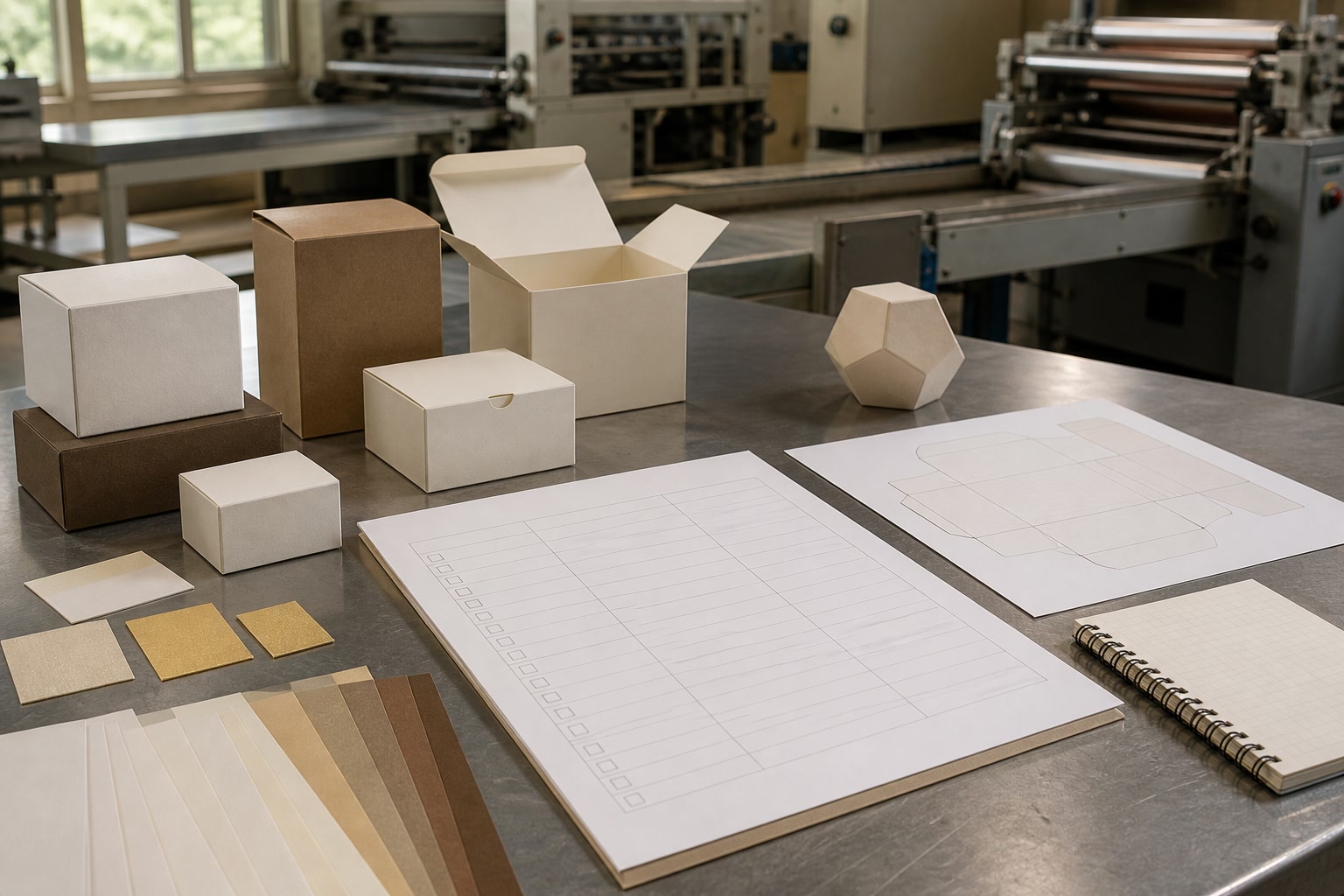
A useful custom packaging brief gives suppliers the information they need to assess feasibility, recommend suitable materials and provide a comparable quote. It should cover the product, box size, quantities, artwork, finishes, packing method and delivery plan — not just a picture of the design you have in mind.
Complete the checklist below before approaching suppliers. It will reduce back-and-forth, expose decisions that affect cost or lead time, and make it easier to compare proposals on a like-for-like basis.
Define the product and sales channel
Start with what the packaging must do. A box that needs to protect a ceramic item through parcel delivery has different requirements from a carton displayed on a retail shelf, even if the product dimensions are identical.
Describe the product in plain terms before discussing materials or print finishes.
Include:
- Product name, type and intended use
- Whether the item is food, cosmetic, electronic, apparel, giftware, jewellery or another category
- The number of units per pack
- Whether accessories, instructions, inserts, samples or chargers sit inside the box
- Whether the product is already in a bottle, pouch, sleeve or other primary packaging
- The expected shelf life or campaign period, where relevant
- Whether the packaging is for a launch, seasonal promotion or ongoing range
Then explain where and how it will be sold.
| Sales channel | Brief details to provide | Packaging implications |
|---|---|---|
| Retail shelf | Retailer type, shelf orientation, display requirements and barcode position | Front-panel impact, neat shelf presentation and consistent carton dimensions may matter most |
| E-commerce | Parcel carrier, fulfilment method, likelihood of mixed-item orders and return process | Protection, compact dimensions, tamper evidence and ease of packing become more important |
| Direct-to-consumer gifting | Whether the box is the gift presentation and whether a message card is included | Premium unboxing, tissue, ribbons, inserts and branded outer packaging may be relevant |
| Wholesale or trade | Units per inner pack, outer case requirement and warehouse handling | Efficient case packing, clear identification and repeatable assembly are key |
| Events or promotional distribution | Handout method, campaign dates and product volume | Portability, rapid assembly and visual visibility can outweigh long-term durability |
Be specific about the customer-facing role of the packaging. For example, “a box for a 30 ml skincare bottle” is incomplete. “A retail-ready gift box for a 30 ml glass skincare bottle, sold online and in boutiques, with a product card and a premium opening experience” gives a supplier far more useful context.
If you are still selecting a format, review the types of custom printed boxes available and state that you need recommendations rather than presenting an untested box style as fixed.
State the packaging objective and priorities
Most packaging decisions involve trade-offs. A concise list of priorities helps a supplier suggest options that fit the job.
Rank the factors that matter most, such as:
- Product protection
- Premium appearance
- Low unit cost
- Reduced material use
- Fast and simple packing
- Flat storage before use
- Retail display impact
- Easy customer opening
- Reusability
- Consistent repeat ordering
Do not assume every objective can be maximised at once. A rigid presentation box may create a stronger premium impression than a folding carton, but can take more storage space and may affect the total packed cost. A very compact mailer can reduce void space, but may leave too little tolerance for manual packing.
Record dimensions, weight and fragile points
Accurate product data is the foundation of a workable packaging specification. Suppliers need the physical dimensions of the packed item, not only the product’s advertised size.
Provide measurements in millimetres and weight in grams or kilograms. Say whether each measurement is final, estimated or subject to change.
Measure the product as it will enter the box
Record:
- Length × width × height of each item
- Product weight
- Shape: rectangular, cylindrical, tapered, irregular or flexible
- Any existing bottle, jar, tube, cap, hanger, pouch or label
- Dimensions of included components and literature
- Whether components are loose, bagged, wrapped or tied together
- The preferred product orientation in the box
- Whether the product must remain upright
For a cylindrical bottle, provide its diameter and total height, including the cap. For an irregular item, provide the widest, tallest and deepest points, plus photographs from several angles. A single dimension can be misleading when a product tapers or has protruding parts.
Identify fragile areas and protection needs
Packaging must protect the weakest point, not merely contain the product. Flag issues early, including:
- Glass, ceramic or easily scratched surfaces
- Pumps, droppers, nozzles, handles or protruding controls
- Corners vulnerable to crushing
- Polished, metallic or coated surfaces prone to scuffing
- Products that leak, melt, settle or shift
- Heavy products likely to move inside a loose-fitting box
- Multiple components that can knock together
A supplier may suggest a fitted insert, divider, collar, tray, wrap or additional clearance. Do not specify an insert material purely because you have seen it elsewhere; its suitability depends on the product weight, tolerances, assembly method and distribution route.
Allow for realistic tolerances
Avoid giving dimensions with false precision. Products and components vary slightly, especially where bottles, textiles, handmade goods or assembled sets are involved.
Your brief should state:
- Normal size variation, if known
- Whether the product is measured before or after wrapping
- Minimum and maximum dimensions
- Acceptable movement inside the box
- Whether packing is manual or automated
- Whether the packaging must accommodate future product variants
A snug fit is not automatically safer. Too little clearance can make packing slow, damage a printed surface during insertion or create problems if the product changes fractionally between batches. Ask the supplier to confirm the proposed internal dimensions and packing tolerance before production.
Set quantity and repeat-order expectations
Quantity affects unit cost, material choices, print methods, set-up requirements and the practicality of bespoke structural work. Give a realistic quantity forecast rather than only the smallest order you would like to place.
Include:
- Initial order quantity
- Expected quantity per design, size or SKU
- Number of artwork versions
- Expected reorder volume and frequency
- Whether the range will expand
- Whether all units are required at once or in phased deliveries
- Whether you need plain samples, printed samples or a structural prototype before a full run
For example, an initial total of 5,000 boxes split across five designs is not commercially equivalent to 5,000 identical boxes. The number of versions affects artwork preparation, print set-up and stock management.
Separate fixed details from estimates
Procurement teams often need an indicative quote before every detail is approved. That is reasonable, but distinguish between confirmed and provisional information.
Use labels such as:
- Confirmed: product size, preferred box format, artwork count
- Estimated: first-year demand, launch date, reorder cadence
- Open for recommendation: board type, insert construction, protective finish
- To be confirmed: final barcode, legal copy, outer-case quantity
This approach lets a supplier provide assumptions transparently. It also helps you compare quotations: one quote may include an insert or a finish that another has excluded.
Ask for a quote structure you can compare
Where possible, request pricing at more than one quantity break, for example your launch quantity, a typical reorder quantity and a higher-volume scenario. Ask suppliers to identify:
- One-off set-up, tooling or artwork charges, where applicable
- Unit price by quantity
- Price difference between design versions
- Sample and prototype costs, if any
- Packing, storage or delivery charges where these apply
- Any assumptions about materials, finish, insert and assembly
The cheapest headline unit price may not represent the lowest total cost once delivery, assembly labour, breakage risk and storage are considered.
Describe brand artwork and finish needs
Artwork information should tell a supplier what exists, what is final and what visual outcome you expect. Sending a logo alone is rarely enough for a print-ready quotation.
Provide:
- Brand guidelines, if available
- Logos in suitable vector format where possible
- Colour references, including named brand colours or Pantone references if used
- Dielines or previous box artwork, if relevant
- Product photography or mock-ups
- Copy, ingredient panels, warnings, barcodes and QR codes that must appear
- The number of print colours and design variants
- Whether artwork is final, in progress or needs adaptation to a dieline
If you have no final artwork, supply a rough layout and clearly state that it is a concept. A supplier can then discuss what is needed for production without treating an early mock-up as final technical artwork.
Specify the intended visual and tactile result
Finish terms can mean different things in practice, so describe the outcome as well as naming the finish. Consider:
- Matte, gloss or soft-touch appearance
- Uncoated, textured or smooth paper feel
- Foil details and their colour
- Embossed or debossed areas
- Spot varnish or raised elements
- Window cut-outs
- Inside printing
- Colour on the box edge, base or interior
- Whether the packaging needs to photograph well for online product listings
For premium presentation, a custom gift packaging format may be more appropriate than a standard folding carton. However, confirm the practical consequences: how it ships flat or assembled, how it is packed, and whether the proposed finish suits the expected handling.
Check artwork compatibility before approval
Certain details need early review because they can affect legibility, registration or the construction itself:
- Very small text, fine lines and reverse-out type
- Large solid colour areas
- Metallic or highly detailed effects
- Barcode placement and quiet zones
- Copy placed across folds, creases or glued areas
- Important graphics near cut lines
- Colour-critical brand elements
- QR codes that must remain scannable after print and finishing
Ask for the dieline before preparing final artwork, and use the supplier’s stated bleed, safe area and file requirements. Do not rely on an on-screen mock-up alone to judge a finish, colour or material texture.
If labels are part of the specification, clarify whether they are applied to the product, the outer box or both. You can explore custom printed stickers and labels separately, but ensure their size, adhesive, surface compatibility and application method are specified.
Confirm packing, assembly and delivery requirements
A strong packaging design can still create costly problems if it is difficult to assemble, awkward to store or unsuitable for the delivery route. Include operational information in the brief from the start.
Explain who packs the product and how
State whether packing is completed by:
- Your own team
- A contract packer
- A fulfilment partner
- A retailer
- The end customer, for self-assembly packaging
Describe the intended sequence: place product in insert, add leaflet, close box, apply seal, pack into shipping carton. This reveals whether tabs are likely to be missed, inserts require too much handling or an elegant closure becomes impractical at volume.
Confirm:
- Required assembly time or simplicity
- Whether staff need visual packing instructions
- Whether left- and right-handed use matters
- Whether tamper seals, labels or sleeves are applied after packing
- Whether packaging must be supplied flat, pre-glued, pre-assembled or in another form
- Whether any packing component is sourced separately
Specify outer packing and storage needs
Do not confuse product packaging with transport packaging. The supplier needs to know how finished boxes will be protected and delivered to your operation.
Include:
- Preferred bundle quantity
- Carton quantity, if known
- Pallet restrictions or warehouse handling limits
- Maximum carton weight, if your team has one
- Available storage space
- Whether boxes need to arrive flat for storage
- Whether you need mixed SKUs separated and clearly identified
- Any requirement for batch, SKU or carton labelling
For e-commerce, explain whether the branded box goes directly into a mailing bag or outer transit carton. If it travels without a protective outer layer, the finish and structural requirements may differ.
Give a realistic delivery brief
State the delivery destination, access constraints and required delivery window once known. If timings are critical, explain the business date driving the requirement — for example, a product launch or retail range reset — rather than simply writing “urgent”.
A useful delivery request identifies:
- Required delivery date or date range
- Whether it is a firm deadline or planning estimate
- Number of delivery locations
- Whether deliveries are phased
- Site opening times and booking requirements
- Any restrictions on vehicle size, unloading or pallet acceptance
- The named contact responsible for goods-in queries
Suppliers should confirm their own production, packing and transport assumptions. Do not treat an estimate as a committed delivery arrangement until the specification, artwork approval, order terms and delivery plan are confirmed.
Build the final supplier handover checklist
Before requesting a quote, put all information into one document or shared folder. A concise brief is easier to evaluate than a long email chain with conflicting attachments.
Use this final custom packaging brief checklist.
Product and use
- Product name, category and SKU count
- Product photographs and, where helpful, a physical sample plan
- Product dimensions, weight and shape
- Components, accessories, leaflets and existing primary packaging
- Fragile points, surface sensitivity and upright requirements
- Sales channel: retail, e-commerce, wholesale, gifting or promotional use
- Primary packaging objective and ranked priorities
Structure and materials
- Preferred packaging format or request for supplier recommendations
- Required internal dimensions or acceptable tolerance range
- Preferred opening, closure and product orientation
- Insert, divider, tray or protective feature requirements
- Flat-packed, glued or assembled supply preference
- Sustainability requirements stated as specific criteria, rather than vague claims
- Any product-specific legal, retailer or labelling obligations identified for review
Artwork and appearance
- Brand guidelines and logo files
- Artwork status: concept, in progress or print-ready
- Design versions, languages and SKUs
- Required copy, barcode, QR code and mandatory product information
- Colour references and colour-critical areas
- Preferred material appearance and print finishes
- Dieline, bleed and safe-area requirements to be confirmed before final artwork
Commercial information
- Initial order quantity and quantities per version
- Forecast reorder volume and likely timing
- Requested quantity breaks for comparison
- Budget guidance, if you can share it
- Need for prototype, plain sample or printed sample
- Request for separated set-up, unit, sample and delivery costs
- Quote validity period and payment requirements to be confirmed with each supplier
Assembly, packing and delivery
- Who assembles and packs the final product
- Required packing sequence and speed considerations
- Outer-carton, bundle and pallet preferences
- Storage restrictions and flat-pack requirements
- Delivery address or addresses
- Required date, phased-delivery needs and goods-in restrictions
- Named operational and artwork contacts for queries and approvals
Common mistakes that weaken a packaging quote
A brief does not need to be perfect, but it should avoid gaps that force suppliers to guess. The most common problems are:
- Requesting a quote without product dimensions. External box dimensions cannot be finalised until the internal fit is understood.
- Quoting one total quantity for multiple designs. Always state the quantity per SKU or artwork version.
- Choosing a box format before defining the sales channel. A retail gift box and a parcel-ready e-commerce pack solve different problems.
- Supplying visual mock-ups as though they are production files. A mock-up communicates intent; it may not contain the technical information needed to print.
- Leaving out inserts, cards or accessories. These can materially change the required internal size and assembly method.
- Treating “eco-friendly” as a complete specification. Explain the material, disposal, recycled-content, plastic-reduction or other criteria that matter to your business.
- Ignoring warehouse realities. A box that looks excellent may be difficult to store, pick or assemble.
- Comparing quotes only by unit price. Include samples, set-up, freight, storage, production assumptions and the actual scope supplied.
FAQ
What is the minimum information needed for a packaging quote?
At minimum, provide product dimensions and weight, desired quantity, packaging type or intended use, artwork status, number of design versions and delivery destination. Add product photos, fragile points and any inserts to make the quote more reliable.
Should I send a product sample to a packaging supplier?
A sample can be very useful for unusual shapes, fragile products, fitted inserts or premium presentation packaging. It does not replace a written specification, however. Include measured dimensions, weight and the expected product variation as well.
Do I need final artwork before asking for a quote?
No. You can request an indicative quote using brand assets, a mock-up and a clear description of the desired finish. State that artwork is provisional, and ask which assumptions the estimate uses. Final pricing and production approval may depend on the completed dieline and print-ready artwork.
How do I compare packaging suppliers fairly?
Give every supplier the same brief and compare the complete scope: box style, dimensions, material assumptions, print and finishes, insert, quantity per design, sample provision, packing format, delivery and one-off charges. Ask questions where an item is not stated clearly rather than assuming it is included.
When should procurement involve product and fulfilment teams?
Involve them before artwork is finalised. Product teams can validate fit and protection, while fulfilment or warehouse teams can assess assembly, storage, labelling and inbound delivery needs. Early input prevents costly changes after structural decisions have been made.
A well-prepared brief lets you seek practical recommendations rather than simply asking suppliers to price an incomplete idea. Once your checklist is complete, use it consistently for each enquiry, retain the agreed specification alongside artwork files, and update it whenever the product, sales channel or delivery process changes. For background on XGolden Print’s packaging capability, see the company overview.