Custom kraft boxes for natural product lines can give products a clear, grounded presentation while protecting them through retail display, fulfilment and delivery. They work especially well for soaps, candles, skincare, teas, dry goods, refill products and small gifts when the box structure, board, print finish and product-contact requirements are specified correctly.
The “natural” look alone is not enough. A good kraft packaging brief balances visual simplicity with practical needs: the weight and shape of the item, resistance to scuffing or moisture, opening experience, barcode placement, any legally required information and the disposal route intended for the finished pack.
Kraft Packaging
Kraft packaging generally uses brown-toned paperboard or corrugated material with visible fibres and a less coated appearance than many white cartonboards. It can help a natural product range feel straightforward, tactile and considered, but it is not one uniform material. Board grade, thickness, surface treatment and construction affect how the finished box looks and performs.
For lightweight retail products, folding cartons are often appropriate. These arrive flat and are formed around the product, making them useful for boxed soap, jars, bottles, pouches and accessory sets. For heavier items, postal packs or larger gift sets, corrugated kraft boxes may provide a more robust format.
Match the box style to the product
Start with the product’s dimensions, weight and vulnerability rather than selecting a style solely from appearance.
| Product requirement | Suitable custom kraft box options | What to check |
|---|---|---|
| Small bar, tin or accessory | Tuck-end carton, sleeve or simple tray | Close fit, tamper needs and easy opening |
| Bottle or jar | Folding carton with insert, crash-lock base or rigid-style box | Base strength, internal movement and neck clearance |
| Fragile or multi-piece gift set | Mailer box, corrugated carton or carton with partitions | Protection, compartment sizing and outer transit packaging |
| Premium seasonal range | Two-piece box, drawer box or presentation box | Assembly, storage space and whether the material supports the intended finish |
| Refill or low-weight pouch | Sleeve, carton or postal box | Product visibility, hanging/display format and moisture exposure |
A box should be large enough to avoid crushing labels, caps and corners, but not so large that the product moves freely. Excess internal space can make a pack look poorly considered and may require additional void fill during dispatch.
Consider the actual product environment
Natural-product lines often include materials that introduce packaging complications. Essential oils, balms, botanical powders, soaps and wax-based products can all behave differently in storage and transit.
For example:
- Oily products may mark unprotected paperboard if a leak occurs. Confirm whether a barrier layer, liner or secondary containment is needed.
- Soap and bath products can be affected by damp conditions. Ensure the board and closure style are suitable for the expected handling environment.
- Glass jars and bottles need protection against impact; a visually attractive carton is not automatically a transit-safe solution.
- Loose tea, powders or food products usually require a primary pack that is suitable for the product. A printed outer kraft carton should not be assumed to provide the necessary barrier.
- Scented products may transfer fragrance to adjacent packaging during storage. Test the complete packed product, especially where several items sit in one gift box.
Where a box will be used for food, cosmetics, supplements or other regulated goods, check the relevant UK requirements for the product category, pack information and material suitability. The printer or box manufacturer can provide material details, but responsibility for confirming a pack’s fitness for the intended use should remain clear in the buying process.
Recyclable
Kraft paperboard is often chosen because it can support a fibre-based disposal route, but recyclability depends on the finished pack rather than the word “kraft” on its own. Coatings, laminations, plastic windows, foil, magnets, adhesive choices and inserted components can change how easily a box can be sorted or processed.
The most straightforward design is usually a mostly paper-based box with minimal added materials. However, the correct choice still depends on the level of protection, product visibility and shelf presentation required.
Design for simpler disposal
If a recyclable presentation is an important part of the packaging strategy, discuss these points early:
- Base board – Ask what fibre content and board composition are offered, and request documentation where needed for your own packaging assessment.
- Print coverage – Consider whether full-coverage dark ink is necessary. A lighter, more selective design preserves more of the natural kraft character and can reduce visual scuffing.
- Surface finish – A coating may improve rub resistance or appearance, but it can affect end-of-life considerations. Compare uncoated, varnished and other available finishes against the actual product needs.
- Windows and inserts – If product visibility is essential, assess whether a window is truly necessary. If it is, make sure customers can understand whether components should be separated before disposal.
- Closures and accessories – Ribbons, magnetic closures, foam, plastic trays and multi-material labels can complicate disposal. Use them only where their function justifies them.
- Consumer messaging – Avoid broad environmental claims unless they can be substantiated for the exact finished pack and its likely disposal route.
Recyclable does not mean a box is suitable for every recycling collection system or condition. Local collection arrangements and the final construction both matter. It is more useful to give clear, accurate disposal instructions than to rely on vague “eco-friendly” wording.
Recycled versus virgin fibre
Both recycled-content and virgin-fibre boards may be considered for custom kraft boxes. The best option depends on print requirements, strength, colour consistency, product-contact needs and the specifications available from the supplier.
Recycled board may show more variation in tone and surface character, which can be desirable for an informal, craft-led brand. Virgin-fibre board may offer different strength or surface properties. Neither option should be treated as automatically better without reviewing the specific material data and the use case.
For a natural product line, it is sensible to define what matters most: a visibly rustic appearance, consistent print colour, robust transit protection, recycled content, or a particular disposal outcome. These priorities can conflict, so rank them before requesting samples.
B2B Printing
B2B printing for custom kraft packaging should be managed as a specification process, not simply an artwork upload. The quote and production plan need to cover the box style, flat size, board, print method, colour treatment, finishes, insert requirements, packing format and order quantity.
A detailed brief reduces the risk of receiving a box that looks right in a digital proof but is impractical once filled, stacked or sent to retailers.
Build a clear packaging specification
Include the following details when comparing packaging suppliers:
- Product dimensions, weight and a photograph or physical sample where possible
- Required internal dimensions and tolerated movement
- Box style and how it will be opened, closed and assembled
- Board preference, including whether a natural brown surface is required inside and outside
- Number of print colours, print areas and any white ink requirement
- Finishes such as debossing, embossing, foil or varnish, if genuinely needed
- Whether an insert, divider, leaflet or tamper feature is required
- Barcode position, batch coding area and any variable information that will be applied later
- Retail shelf orientation, e-commerce use, or both
- Quantity by design, including whether several product variants share one structure
- Required delivery format, such as flat-packed cartons or assembled boxes
If you are buying for multiple stock keeping units, consider a family system. One common box structure with changing labels, sleeves or a small printed panel can simplify inventory while maintaining range recognition. Conversely, separate fully printed cartons may be worthwhile where clear product differentiation is important on shelf.
Printing on brown kraft board
Brown kraft is not a neutral white canvas. Printed colours can appear warmer, darker or less vivid because the substrate influences the ink. This is particularly important for pale shades, pastels and colours that must closely match a brand identity.
White ink beneath a coloured design can improve brightness, but it changes the visual language from raw kraft towards a more printed, graphic look. It can also add complexity to the artwork and print process. Ask for a proof or sample on the intended board rather than judging colours only from a screen or a white-paper printout.
Fine text, very thin lines and small reversed-out details may need adjustment for reliable legibility. Keep ingredient lists, directions, warning text and batch areas clear, with sufficient contrast and type size for their purpose. Confirm final artwork requirements with the production team before approval.
Do not overlook operational details
A well-designed carton can create problems if it slows fulfilment or retail preparation. Test whether the box can be assembled efficiently, whether it stays closed during handling, and whether labels can be applied without covering important graphics.
For e-commerce, distinguish between the product box and the shipping pack. A retail carton may protect the product from light scuffs but still need an outer postal box, padding or dividers. Asking one box to perform every function can lead to over-engineering or insufficient protection.
Natural Style
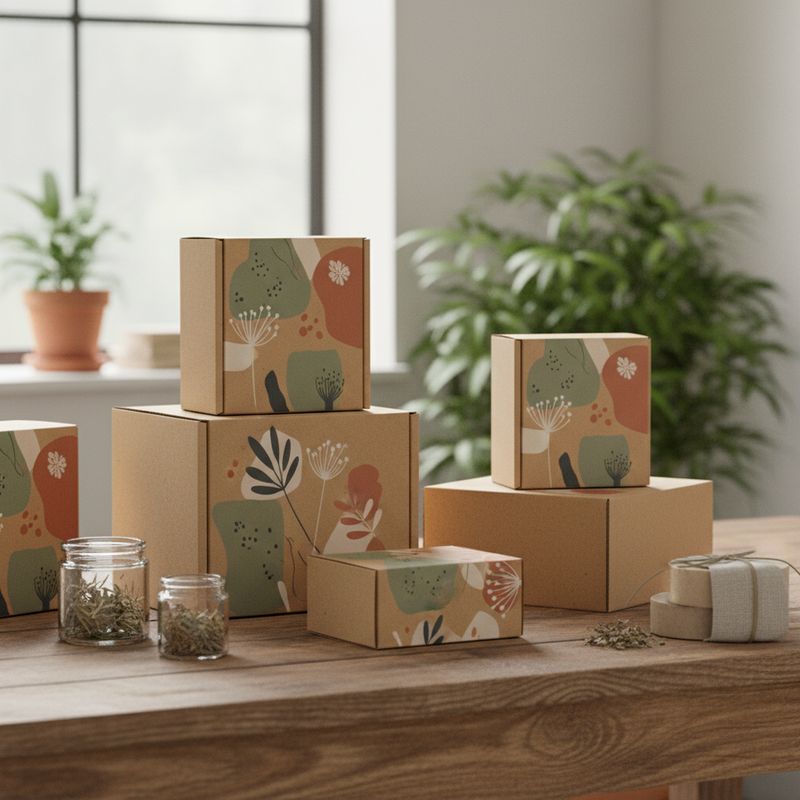
A natural style does not require every box to be plain brown with black print. The strongest designs use the characteristics of kraft board deliberately, then add colour, texture and information in ways that make the product easy to understand.
The visual goal is credibility and clarity, not an assumed environmental promise. A botanical skincare range, handmade soap collection and premium pantry brand may all use kraft packaging, yet need very different design approaches.
Create a clear visual hierarchy
On a small box, prioritise the information a customer needs first:
- Brand or product line
- Product name and variant
- Product type or primary benefit, where appropriate
- Size, quantity or key practical detail
- Required product information
- Instructions, ingredients or supporting copy
Avoid covering every panel with leaf motifs, claims and decorative copy. Unprinted space can make the natural board feel intentional while improving readability. Use colour coding sparingly to distinguish fragrances, flavours or product types, particularly when a range is displayed together.
Texture can add value without making the design busy. A subtle emboss, deboss or carefully chosen uncoated surface may be more aligned with a natural product line than a high-gloss finish. However, tactile features should be tested against handling, storage and the risk of scuffing.
Use claims carefully
Words such as “natural”, “organic”, “plastic-free”, “compostable” and “recyclable” can have specific implications. Ensure any on-pack environmental or product claim is accurate, supportable and suitable for the item sold in the UK.
It is also wise to separate the product claim from the packaging claim. A product made with plant-derived ingredients does not automatically mean that every element of its packaging has a particular environmental attribute. Precise language is more trustworthy and easier to maintain as packaging specifications change.
Custom Design
Custom design is valuable when it improves fit, usability, merchandising or brand recognition. It does not always mean creating an elaborate bespoke structure. A standard carton style adapted to the exact product dimensions, with carefully planned print and an appropriate insert, can be a genuinely custom solution.
Choose the right level of customisation
Use this decision guide when developing a new kraft box programme:
| Priority | Design approach to consider | Potential trade-off |
|---|---|---|
| Lowest complexity | Standard box style with a label or printed sleeve | Less distinctive structural presentation |
| Better shelf impact | Fully printed folding carton in a custom size | More artwork coordination and stock management |
| Added protection | Carton with fitted insert or divider | More material and component specification |
| Gift-ready presentation | Rigid-style or premium opening format | Higher space, assembly and fulfilment considerations |
| Flexible range management | Shared outer box with variant labels or sleeves | Reduced differentiation without strong label design |
| Strong unboxing experience | Branded mailer with internal print | Must still be assessed for product protection and disposal |
Before committing to a full production run, review a physical sample with the actual item inside. Check the product fit, panel alignment, closure, print legibility and whether the packaging withstands normal handling. If the pack will be sold online, inspect how it arrives after being placed inside the intended outer shipping arrangement.
Common mistakes to avoid
Several issues repeatedly weaken otherwise attractive kraft packaging:
- Selecting board by appearance before checking its strength and suitability
- Assuming a kraft carton is automatically recyclable in its final form
- Expecting brand colours to reproduce identically on brown stock without testing
- Leaving too little room for labels, barcodes, batch codes or mandatory copy
- Designing small text with insufficient contrast
- Adding a window, coating or insert without considering its practical purpose
- Using a retail box as the only protection for a fragile product in transit
- Ordering multiple variants without a clear version-control process for artwork
A final approved dieline, print-ready artwork file and written specification help prevent ambiguity. Keep records of board choice, approved sample, colour expectations and revision numbers so future reorders remain consistent.
Questions to ask before ordering custom kraft boxes
Can kraft boxes be used for products described as natural?
Yes. Kraft cartons can suit many natural product ranges because the material’s appearance supports a simple, tactile presentation. The product description and the packaging material are separate matters, though: make sure any claims about the product or pack are accurate and verifiable.
Are custom kraft boxes suitable for food or cosmetics?
They can be used as outer packaging, but suitability depends on the product, whether there is direct contact, the primary container, inks, coatings and the applicable requirements. Confirm the finished specification for the intended use rather than relying on a general material description.
Is brown kraft better than white board?
Neither is universally better. Brown kraft offers a distinctive, less polished appearance and can work well with restrained graphics. White board may be preferable for exact colour reproduction, fine detail or a brighter premium look. Compare physical samples with your actual artwork.
What information should be supplied to a packaging printer?
Provide product dimensions and weight, box style, quantity, artwork, print colours, board preference, required finish, any insert details and how the box will be used in retail or dispatch. Also identify areas for barcodes, batch codes and product information.
How can a brand make kraft packaging look premium?
Focus on proportion, fit, legible typography and a controlled print palette. An elegant opening mechanism, well-designed insert or subtle tactile detail can add perceived value, but only if it supports the product and does not create unnecessary complexity.
A considered brief is the best starting point for custom kraft packaging. Define the product’s protection needs, desired material appearance, print priorities and disposal considerations, then compare sample constructions before placing an order. For structural options beyond kraft cartons, explore custom packaging boxes that can be specified around your product format.