The right custom box insert holds the product securely without making it difficult to remove, protects the areas most likely to break or scuff, and supports the unboxing experience your brand needs. Start with the product’s weight, weak points and journey through packing, storage and delivery—not simply the material that looks best in a sample.
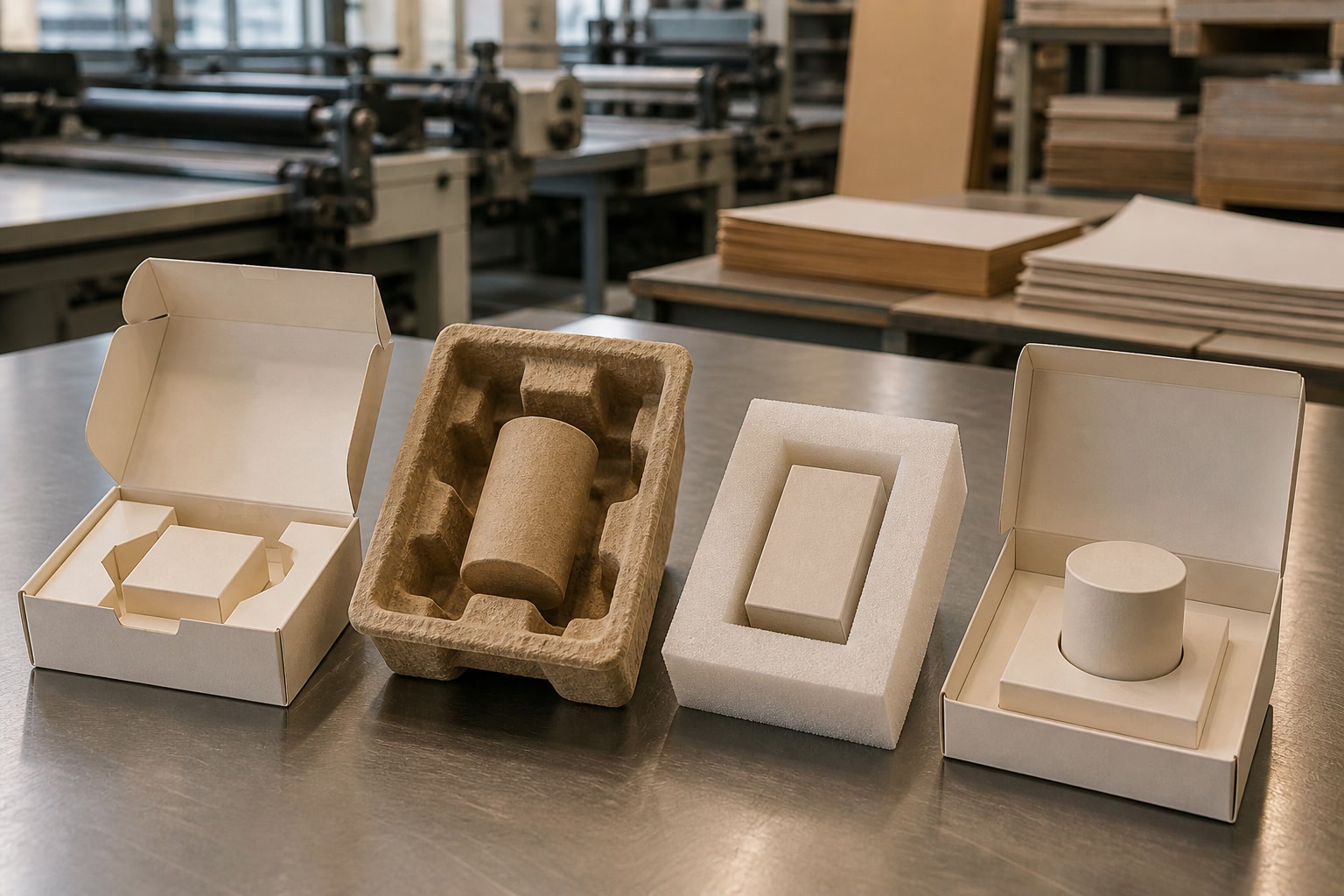
For most projects, paperboard inserts suit lightweight to medium-weight products and branded presentation; moulded pulp offers a more protective formed option with a fibre-based appearance; foam supports delicate or heavier items; and platform inserts create a premium display layer. The best custom box insert selection balances all four priorities: protection, fit, assembly and end-of-life handling.
Start with product weight and fragile areas
An insert is not a substitute for a suitably strong outer box. Its role is to control movement inside the pack, separate components and protect the product from rubbing, impact and pressure. Before choosing an insert style, document the product properly.
Record:
- Overall length, width and height, including lids, handles, cables and protrusions
- Product weight, both individually and as a complete set
- Fragile areas, such as glass edges, corners, screens, caps, pumps and decorative finishes
- Surfaces prone to scratching, colour transfer or abrasion
- Components that must be kept apart, including accessories, chargers, samples or paperwork
- Whether the product is packed manually, semi-automatically or by a fulfilment team
- The likely distribution route, including parcel shipping, retail replenishment or direct handover
Weight influences how much support the insert must provide. A lightweight candle carton may only need a folded card collar to stop sideways movement. A heavier jar, bottle or electronic item may require support beneath the base as well as around the sides. If the product can drop onto an unsupported corner when the carton is tipped, it needs a different insert design.
Fragile areas should dictate the contact points. For example, a bottle insert should generally support the stronger body or shoulder rather than place pressure against a closure. A display insert for a cosmetic compact should avoid rubbing against a decorated lid. For a gift set, separate wells can stop metal, glass and paperboard components from knocking together.
A useful rule is to design for controlled movement rather than an excessively tight squeeze. A product that is difficult to insert can slow packing, damage soft finishes and frustrate the recipient. Conversely, visible gaps may allow the item to rattle and make a premium pack appear poorly specified.
Compare paperboard, moulded pulp, foam and platform inserts
The four common approaches solve different problems. There is no universally best choice: material and construction should follow the product, packing method, visual brief and disposal plan.
| Insert approach | Best suited to | Protection and retention | Presentation | Assembly considerations | End-of-life considerations |
|---|---|---|---|---|---|
| Folded paperboard | Lightweight to medium-weight goods, gift sets, cartons and accessories | Good separation and positional control when well designed; limited cushioning for severe impact | Clean, printable and easy to colour-match with the box | Can arrive flat or pre-assembled; complex folds add packing steps | Fibre-based options may be easier to separate where uncoated and accepted locally |
| Moulded pulp | Bottles, jars, electronics, sets and products needing shaped support | Good formed cradle and impact management; geometry is important | Natural, tactile appearance; less suitable where a sharp luxury finish is needed | Typically supplied formed; can simplify product placement | Often fibre-based, but local disposal guidance and any coatings or mixed parts should be checked |
| Foam | Delicate, high-value, heavy or precision-shaped products | Strong cushioning and close retention; useful for sensitive edges and cavities | Can look technical or premium depending on finish, but is less easily printed | Often supplied die-cut or fabricated; may need careful orientation during packing | Disposal routes vary considerably by foam type and local collection systems |
| Platform or raised insert | Premium gifts, retail presentation, launch packs and layered sets | Supports the product from below; usually paired with a tray, collar or recess for secure retention | Strong reveal effect and room for messaging beneath or around the product | May involve several pieces and a more deliberate packing sequence | Depends on the platform material, coverings, adhesives and any mixed-material construction |
Folded paperboard inserts
Paperboard inserts include simple pads, collars, dividers, sleeves, die-cut trays and folded cradles. They are often a sensible starting point for custom boxes because they can be designed to match the outer pack’s print, colour and visual style.
Their main strength is versatility. A well-engineered board insert can create separate compartments, hold a product upright, cover accessories and provide a branded panel for instructions or a message. It can also be supplied flat to reduce storage volume, although that shifts some work to the packing line.
Paperboard has limits. A thin folded insert may deform under a heavy product, and it does not offer the same cushioning as a resilient material. Increase support through structural design—such as return folds, base panels and interlocking tabs—rather than assuming a thicker board alone will solve the issue.
Choose paperboard where the main need is organisation, light retention and visual integration, particularly for cosmetics, stationery, apparel accessories, confectionery-style gift sets and similar products.
Moulded pulp inserts
Moulded pulp forms a shaped cradle around the product. It can be particularly useful where a product needs support around its contour, including the base, shoulders or corners. Its tactile, fibre-based surface can work well for brands seeking a restrained, natural-looking pack.
The design needs careful attention to tolerances. Products with variable dimensions, handmade forms or soft labels may not sit consistently in a closely contoured cavity. Consider whether the insert needs clearance for a label seam, a protective bag, a bottle cap or a slight manufacturing variation.
Moulded pulp is not automatically the right choice simply because it appears fibre-based. Coatings, colour treatments, added labels, adhesive-backed features and other components can change the disposal picture. Ask what material mix is proposed and how the completed pack should be separated.
Foam inserts
Foam is often selected when product protection is the leading concern. Die-cut or fabricated foam can create close-fitting recesses, support heavy objects and cushion vulnerable surfaces. It is commonly considered for products with glass parts, polished finishes, instruments, technical components or an unusually sensitive shape.
However, foam needs a clear reason. It can introduce an additional material type into the pack, and its appearance may not support every brand’s visual direction. It can also create friction against certain finishes if the fit is too tight or if the product is repeatedly removed and replaced.
Specify the foam type, density, colour, thickness and finish according to the product and distribution risks. Do not approve a foam insert based on appearance alone. Test whether the item is easy to remove, whether dust or marks are transferred, and whether contact points leave impressions after time in the pack.
Platform and raised inserts
A platform insert lifts the product closer to the opening of the box, creating a reveal when the lid is removed. It can make a small item feel more considered in a larger gift box and create space beneath the product for a card, leaflet, accessory or secondary compartment.
A platform is primarily a presentation structure. It may not stop lateral movement by itself. In many designs, it works alongside a shaped tray, collar, ribbon pull or side supports. The combined structure should be assessed as a system, particularly when the box is likely to be sent through a parcel network.
This option suits premium gifting, influencer mailers, product launches and retail-ready sets where the first view of the product matters. Keep the construction proportionate: a complicated multi-part insert can look impressive but add unnecessary labour, weight and opportunities for assembly error.
Plan fit, retention and finger access
A product should feel intentional in its cavity: secure enough not to shift during normal handling, yet easy to remove without force. This is where many attractive packaging concepts fail in practice.
Plan three elements together:
- Cavity clearance – Allow for realistic product variation, labels, wraps and protective sleeves. A nominal product size is not always its packed size.
- Retention features – Use shoulders, side tabs, collars, partitions, recesses or controlled compression to prevent movement.
- Removal access – Provide a finger notch, thumb cut-out, ribbon pull, lift tab or a gap at an appropriate edge.
Finger access deserves early attention. If the product sits flush in a deep, close-fitting well, users may need to turn the box upside down or press against a delicate surface to remove it. A thumb notch can solve this, but it should be located away from the area requiring the most support.
For heavier products, test removal with one hand and two hands. For small products, ensure the opening does not expose too much of the item or allow it to escape if the pack is inverted. For sets, identify the removal order: the customer may need to lift a card or accessory before accessing the main product.
Common fit mistakes include:
- Copying a product’s catalogue dimensions without measuring the physical packed item
- Forgetting labels, tamper seals, protective bags or bundle bands
- Designing an insert that grips a lid, pump or other weak component
- Adding a pull ribbon without allowing enough room for it to function
- Leaving compartments so deep that the product cannot be removed comfortably
- Creating sharp paperboard edges that can catch delicate surfaces
Consider presentation and assembly
The insert should reinforce the product’s value rather than compete with it. In a gift box, the insert often determines what customers see first. In a retail carton, it can organise the contents and communicate quality before the product is handled.
Choose the visual treatment according to the desired role:
- Minimal and efficient: unprinted folded board, a simple divider or a shallow tray
- Branded and coordinated: printed paperboard in colours that align with the box artwork
- Natural and tactile: moulded pulp or uncoated board
- Premium reveal: a raised platform, wrapped board structure, ribbon pull or layered presentation
- Technical and protective: shaped foam with clearly organised compartments
Presentation must remain practical for the people packing the box. Review the packing sequence from start to finish. Can an operator identify the correct orientation quickly? Are there several loose parts? Must adhesives be applied? Does an accessory need to sit beneath the product before the platform is added?
If e-commerce fulfilment is involved, reduce avoidable decisions. Clear asymmetry, printed orientation marks concealed from the recipient, or one-way interlocking features can help prevent reversed inserts and incorrectly placed products.
When specifying custom boxes, treat the outer box and insert as one design. The insert’s height affects lid clearance; its footprint affects internal dimensions; and its weight can affect the overall pack. A box that looks right in an empty sample can become too tight once the insert, product, literature and protective wrap are included.
For a gifting project, the insert should also support the reveal sequence. Explore gift packaging options alongside the product arrangement, rather than choosing a decorative box and attempting to fit the contents afterwards.
Review material compatibility and disposal questions
Material selection involves more than whether an insert is paperboard, pulp or foam. Check how the insert interacts with the product and how recipients are likely to handle the pack after use.
Product compatibility checks
Ask whether the insert material could cause an unwanted effect on the product over the expected storage period. Particular attention is useful for:
- Gloss, metallic, soft-touch or easily marked finishes
- Printed labels that could scuff against a rough surface
- Glass and polished metal components
- Oils, fragrances, waxes, liquids or powders that may leak
- Food-contact applications, where specific material suitability needs confirming
- Products sensitive to dust, static or moisture
Do not assume all papers, pulps, adhesives, coatings and foams are interchangeable. If compatibility is important, provide representative product samples and define the expected storage and transport conditions before final approval.
Disposal and separation questions
In the UK, household recycling acceptance can vary by local authority and by the material construction. Avoid broad disposal claims unless the exact pack materials, components and relevant collection guidance have been verified.
Instead, ask practical questions:
- Is the insert made from one material or several bonded layers?
- Are there laminated films, foils, magnets, ribbons, plastic windows or foam pads?
- Can the recipient separate these parts easily?
- Is printing, coating or adhesive likely to affect the intended disposal route?
- Does the insert need a disposal instruction, and is that instruction appropriate for the actual pack?
A simple, easily separable construction is often easier for customers to understand than a premium-looking structure made from permanently bonded mixed materials. This does not mean every pack must use one material. It means mixed materials should have a clear functional or presentation benefit.
Approve the insert through fit testing
A digital drawing and an empty prototype cannot fully prove that an insert will work. Fit testing with real products is the most reliable way to identify retention, accessibility and assembly issues before a production order.
Use a structured approval process.
1. Test production-representative products
Use samples that match the intended product as closely as possible, including labels, closures, accessories and protective wraps. If product dimensions vary, test the smallest and largest expected examples.
2. Check placement and removal
Place each item into the insert several times. Look for snagging, unexpected pressure points, difficult orientation or excessive force. Then remove it as a customer would. Confirm that pull tabs, finger notches and ribbons actually work when the box is full.
3. Assess movement in the closed box
Close the complete pack and gently handle it in different orientations. Listen and feel for movement. Check whether contents touch each other, the lid or the outer walls. The goal is not necessarily zero movement in every case, but movement should not create a realistic risk of damage or an untidy presentation.
4. Review assembly with the intended packing method
Time is not the only assembly concern. Watch for confusing steps, parts that can be fitted backwards, tabs that catch, inserts that spring open or components that require excessive manual adjustment. A design that is simple to assemble consistently is often more valuable than one with an elaborate but unreliable feature.
5. Inspect after handling
Open the pack after testing and inspect the product and insert. Look for scuffs, compression marks, dust, tearing, crushed corners, loose accessories and shifted print materials. Repeat the review after the pack has been stored for a suitable period if prolonged contact could affect the product finish.
6. Record approval criteria
Agree what must be true before the insert is signed off. Typical criteria include correct product fit, safe removal, satisfactory appearance, stable component placement, acceptable assembly process and no visible product marking. Keep the approved sample, dimensions and construction notes together so future repeat orders can be checked against the same reference.
Frequently asked questions
Is a paperboard insert protective enough for parcel delivery?
It can be, depending on the product weight, fragility, box strength and insert structure. Paperboard is often effective for separation and positional control, but highly fragile or heavy products may need more cushioning, stronger geometry or a different material. Test the complete packed product rather than judging the insert in isolation.
Should an insert fit tightly around the product?
Not always. It should retain the product without crushing it, rubbing sensitive surfaces or making removal difficult. Allowance may be needed for labels, protective wrapping and normal variation in the product’s dimensions.
Are moulded pulp inserts always recyclable?
No universal statement is appropriate. The material composition, coatings, added components and local household collection arrangements all matter. Confirm the construction and provide disposal guidance only where it accurately reflects the finished pack.
When is a platform insert worth using?
Use a platform when the reveal and product positioning add value, such as premium gifts, launch boxes or retail presentation. Pair it with appropriate retention features if the pack will be transported, because a raised product may need side or base support as well.
A strong custom box insert selection begins with the physical product and ends with a tested, packable solution. Share accurate product samples, dimensions, component lists and intended packing method when developing the box, then approve the final structure through real fit testing. XGolden Print can support custom packaging projects where the outer box and insert need to be planned together.