
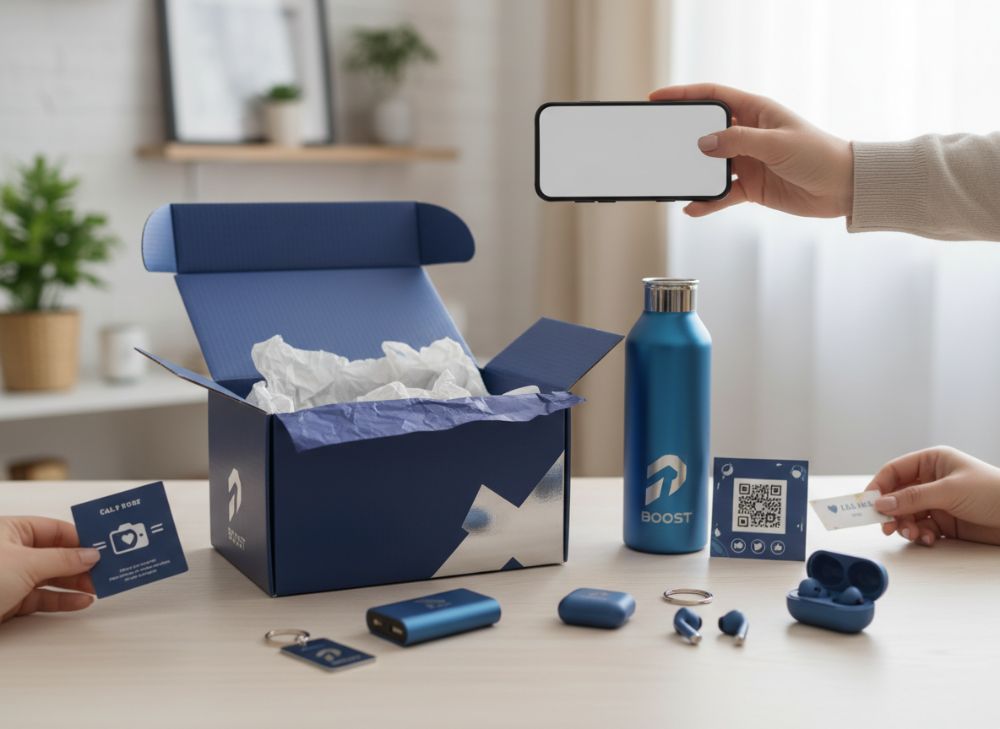
Custom packaging can boost brand visibility on social media when it gives customers a clear reason to photograph, scan, share or take part. The most effective approach is not to make every surface busy; it is to build one memorable visual moment and one simple action into the unboxing journey.
For UK brands, social-ready packaging should still protect the product, suit the sales channel and be practical to produce. Start with a packaging concept that reflects your brand, then decide whether the priority is photo sharing, creator content, reviews, a competition or repeat purchases. Each goal calls for a different call-to-action (CTA) and measurement method.
Encouraging Photo Shares with Great Unboxing
An unboxing experience is shareable when it feels intentional from the outer parcel or shipping box through to the product reveal. Small details often matter more than adding multiple expensive components: a recognisable colour, a neatly placed message, a tactile finish or a well-composed insert can make the opening feel worth recording.
Build the experience in layers:
- Create recognition before opening. Use a distinctive logo treatment, colour palette or pattern on the outer-facing packaging where appropriate.
- Give the opening a clear sequence. A sleeve, seal, tissue wrap, inner tray or folded message can make the reveal feel considered.
- Place the visual highlight inside. The product, an illustrated interior, a short statement or a limited-edition design can provide the “reveal” moment.
- Offer a gentle sharing prompt. A line such as “Show us how you style yours” is more inviting than a demanding instruction.
- Keep the prompt easy to find. Put it where customers naturally look after opening, rather than hiding it under layers of packaging.
The packaging should remain easy to open and appropriate for the product. Over-complicated layers can frustrate customers, while delicate decorative elements may not suit a parcel that will be handled repeatedly in transit.
A practical brief for a custom box should define both functional and social goals. Specify the product dimensions, protection needs, opening method, print areas, expected customer journey and the one action you would most like the recipient to take.
Using Label Stickers as a Call-to-Action
Label stickers are a flexible way to connect packaging to a campaign without redesigning every printed panel. They can be used on boxes, tissue seals, jars, mailing bags, product wraps and order inserts, provided the adhesive and material work with the chosen surface.
A sticker CTA is most effective when it asks for one straightforward action:
- Share an unboxing image or video using a campaign hashtag
- Scan a QR code for styling ideas or care information
- Leave a product review after trying the item
- Enter a seasonal giveaway
- Follow a social profile for new launches
- Reuse or repurpose the packaging and share the result
Keep the copy short enough to read at a glance. If a customer has to interpret several instructions, they are unlikely to act. A clear visual hierarchy usually includes the action first, followed by the handle, QR code or short campaign phrase.
For changing promotions, smaller runs of custom printed stickers can be more adaptable than permanently printing a time-sensitive message onto every box. Confirm the intended application surface, storage conditions, print finish and the legibility of any small text or code before committing to production.
Sticker CTA examples
| Campaign aim | Packaging message approach | What to avoid |
|---|---|---|
| Encourage shares | “Share your unboxing with @brand” | Long lists of social platforms |
| Build a content library | “Tag us for a chance to be featured” | Promising features you cannot review or manage |
| Promote a launch | “Scan to see the full collection” | Sending users to an outdated landing page |
| Gain feedback | “Tell us what you think” | Asking for a review before the product can be used |
| Support a giveaway | “Scan to enter” | Omitting clear entry terms and closing details |
If the CTA collects personal data, runs a prize draw or uses tracking, make sure the relevant terms, privacy information and promotional requirements for your market are available and accurate. Packaging has limited space, so a QR code can point to the full details.
Creating Shareable Gift Packaging Moments
Gift packaging naturally lends itself to social sharing because it marks an occasion and makes the recipient part of the story. The objective is to give the giver confidence that the product looks special before it is opened, while giving the recipient a presentation they may want to photograph.
Design features that can help include:
- A presentation box with a satisfying opening mechanism
- A coordinated lid, sleeve, ribbon area or closure sticker
- A blank or branded space for a handwritten gift message
- Seasonal artwork that suits a specific celebration without becoming overly generic
- A reusable box format that can have a second life for keepsakes or storage
- An inside-lid message that creates a reveal when opened
The key is to match the level of presentation to the product and customer expectation. A luxury-looking rigid format may be suitable for a premium gift, whereas a simple folded carton with an elegant label could be more suitable for a lighter product or larger volume requirement.
When comparing gift packaging options, assess more than the appearance. Check the assembled size, whether the pack is supplied flat or formed, how it will hold the product, the available print area, compatibility with any inserts and whether the closure remains secure through handling.
Avoid placing a prominent social prompt on the most personal part of a gift message. A discreet prompt on the underside, side panel or insert can preserve the recipient’s experience.
Adding QR Codes to Boxes for Contests
QR codes make it possible to add digital content without overcrowding a box. They work best when the customer understands what they will receive after scanning. “Scan to enter”, “Scan for the playlist” or “Scan for styling ideas” gives a clearer reason than a code alone.
For a contest, the code can lead to a mobile-friendly page with entry details, eligibility information, closing dates and contact information. This is useful because campaign details often require more space than packaging can accommodate.
Before printing QR codes on packaging, check the following:
- Destination: Use a dedicated page rather than a generic homepage.
- Mobile experience: The landing page should be readable and usable on a phone.
- Contrast: A dark code on a light, non-reflective background is generally easier to scan.
- Clear space: Do not crowd the code with borders, patterns, folds, seams or essential copy.
- Size and placement: Test a production-representative sample at the likely viewing distance.
- Code management: Decide whether the code is permanent or campaign-specific.
- Fallback route: Include a short, readable web address or an alternative route where space permits.
- Campaign governance: Confirm all terms, permissions and data handling requirements before launch.
A dynamic QR code may allow the online destination to be changed later, but it also creates an ongoing dependency on the chosen service or redirect. A static code is simpler but cannot be updated once printed. Select the method based on how long the packaging will remain in circulation and who will maintain the destination page.
Do not use QR codes solely because they are fashionable. If the linked content is no more useful than what is already on the box, scanning creates friction rather than value.
User-Generated Content from Packaging
User-generated content (UGC) is content made by customers rather than the brand. Packaging can encourage it by creating a recognisable backdrop, providing a prompt and making the brand easy to identify in a photo or video.
A workable UGC system has four parts:
- A shareable trigger: an attractive product reveal, playful message, collectible graphic or useful packaging feature.
- A discoverable identifier: a clear social handle, distinctive campaign phrase or hashtag.
- A practical destination: a profile, landing page or campaign page with relevant content.
- A permission process: a reliable way to request and record permission before reusing a customer’s content.
Do not assume that a public tag gives a brand unrestricted rights to reuse a customer’s photo, video or written content. Set an internal process for asking permission and ensure the person handling community messages knows what approval is required. Take particular care if content includes children, other identifiable people, private homes or third-party creative work.
Packaging prompts should also be authentic to the product. For example, a recipe product may invite serving ideas; a beauty product may invite a finished look; a homeware product may invite a styled shelf or table. Generic requests for “content” are less likely to inspire customers than prompts tied to how they actually use the item.
Designing Boxes to Be Visually Instagrammable
“Instagrammable” packaging is not simply bright packaging. It is packaging that remains visually recognisable in a quick photograph or short-form video. It should have a focal point, enough contrast to read on screen and a form that looks good from likely angles.
Consider these design decisions during development:
Choose one focal feature
Give the box a primary visual element: a bold mark, illustration, colour block, repeated pattern, unusual opening reveal or neatly framed product window. If every panel competes for attention, images can look cluttered.
Design for the camera angle
Customers commonly show the front face, lid, interior reveal and product alongside the opened packaging. Map these views before finalising artwork. A beautiful front panel may not be enough if the top-down unboxing view has no visual interest.
Use finishes with purpose
Foil, embossing, debossing, spot varnish and textured materials can add depth, but their effect changes under household lighting and phone cameras. Subtle finishes can disappear in a photograph, while highly reflective surfaces can create glare. Request samples or proofs where possible and assess the artwork under realistic viewing conditions.
Protect readability
Brand names, product names and instructions still need to be legible. Do not place essential information across folds, near closure points or over complex imagery. Ensure any legal, safety, ingredient, disposal or product-specific information required for the item is verified separately for the relevant market and product category.
Consider packaging afterlife
A box that is worth keeping can extend brand exposure beyond the delivery day. However, reuse should be a genuine design advantage, not an unsupported environmental claim. If you make sustainability-related statements, ensure they are specific, substantiated and appropriate to the materials and disposal routes involved.
Influencer Marketing and Packaging
Packaging can make influencer activity more coherent by creating a consistent visual identity across product sends, launch content and customer orders. However, a creator mailer should not be treated as the same thing as ordinary retail packaging.
For influencer packaging, decide first what the recipient needs to show. If the aim is a quick product demonstration, the pack should open simply and reveal the product immediately. If the aim is a longer story, an insert can outline the product concept, key features and relevant campaign details. Keep the information factual and avoid scripting claims that cannot be supported.
A useful creator-packaging brief may cover:
- Product arrangement and protection
- Opening sequence and likely filming angle
- Brand marks and campaign artwork
- A concise product information card
- Any required disclosure or campaign guidance
- Whether the packaging should be returned, reused or recycled
- The difference between a one-off mailer and the packaging customers receive
Avoid making the package so elaborate that it distracts from the product. The best creator packaging makes filming easier, not more complicated. It should also be feasible within your budget, quantity and fulfilment process if it will be used at scale.
If working with paid or gifted creators, ensure all commercial relationships and content disclosures are handled correctly for the channels and market concerned. The packaging can support transparency, but it does not replace the creator’s disclosure responsibilities.
Measuring Social Engagement from Unboxing
To know whether social-integrated packaging is working, measure the response against a defined objective. Likes alone rarely show whether the packaging contributed to useful business outcomes.
Set a baseline before a new packaging run where possible, then use unique identifiers for each campaign. A unique QR code, campaign-specific landing page, dedicated hashtag or creator code can help distinguish packaging-driven activity from other marketing.
| Objective | Useful indicators | Packaging mechanism |
|---|---|---|
| Improve awareness | Tagged posts, mentions, reach of reposted content | Branded visual design and social handle |
| Encourage participation | QR scans, valid competition entries, landing-page visits | QR code and clear contest CTA |
| Gather UGC | Number and relevance of tagged submissions, approved reuse permissions | Prompt, hashtag and shareable reveal |
| Support product education | Page visits, video completions, repeat scans | QR code linking to useful guidance |
| Encourage repeat purchase | Redeemed offer codes, return visits, email sign-ups where consented | Insert or sticker with a clear value exchange |
| Assess customer response | Review volume and themes, support queries linked to unboxing | Post-use feedback prompt |
Interpret results carefully. A low number of tagged posts does not necessarily mean the packaging failed; customers may enjoy the experience without publishing it. Likewise, a high scan count does not prove that the content persuaded someone to buy again. Combine quantitative indicators with qualitative checks, such as reviewing comments, customer service feedback and the kinds of images people choose to share.
Common measurement mistakes
- Changing the packaging, campaign message and landing page simultaneously, making results difficult to interpret
- Reusing one generic QR code for unrelated promotions
- Measuring activity without setting a target or timeframe
- Failing to check whether the QR destination still works after a campaign ends
- Counting unapproved customer content as reusable marketing material
- Ignoring the cost, assembly time and operational complexity added by special packaging elements
A practical checklist before ordering
Before finalising social-media-led packaging, confirm:
- The primary campaign aim and one desired customer action
- The packaging format’s suitability for the product and sales channel
- The final size, artwork areas, closure method and protective requirements
- Whether stickers, QR codes and inserts are necessary or merely decorative
- The destination, ownership and maintenance plan for every QR code
- Readability of social handles, codes and small type at final print size
- Terms, privacy information and permissions needed for any campaign
- A method for monitoring results and reviewing performance
- The ability to update time-sensitive campaign elements without wasting stock
XGolden Print can support brands developing printed boxes, labels and presentation formats, drawing on 27 years of packaging and printing experience. For a stronger brief, begin by choosing the social action your packaging should encourage, then match the format, artwork and CTA to that single objective.