
A packaging quote is only comparable when it shows what is included, what is optional and what can change after approval. The unit price for a custom box, label or gift pack may exclude one-off setup, sampling, amendments, storage or transport costs that materially affect the total purchase cost.
The most reliable approach is to request an itemised quote before placing an order. Ask the supplier to separate recurring costs from one-off charges, state assumptions about artwork and delivery, and identify any costs triggered by changes. The seven hidden costs in custom packaging quotes you must clarify are usually not dishonest additions; they are commercial details that may simply sit outside a headline unit price.
Use this checklist when comparing suppliers:
- Is the quoted price based on your final size, material, print process, finish and quantity?
- Which charges apply once per design, once per order, or per production run?
- Does the quote include a proof, physical sample and subsequent corrections?
- Are delivery, import duties and taxes included or shown separately?
- What happens if your order quantity, artwork or delivery date changes?
- How long will any custom tooling, stock or finished goods be held, and at what cost?
Plate and Die Setup Charges
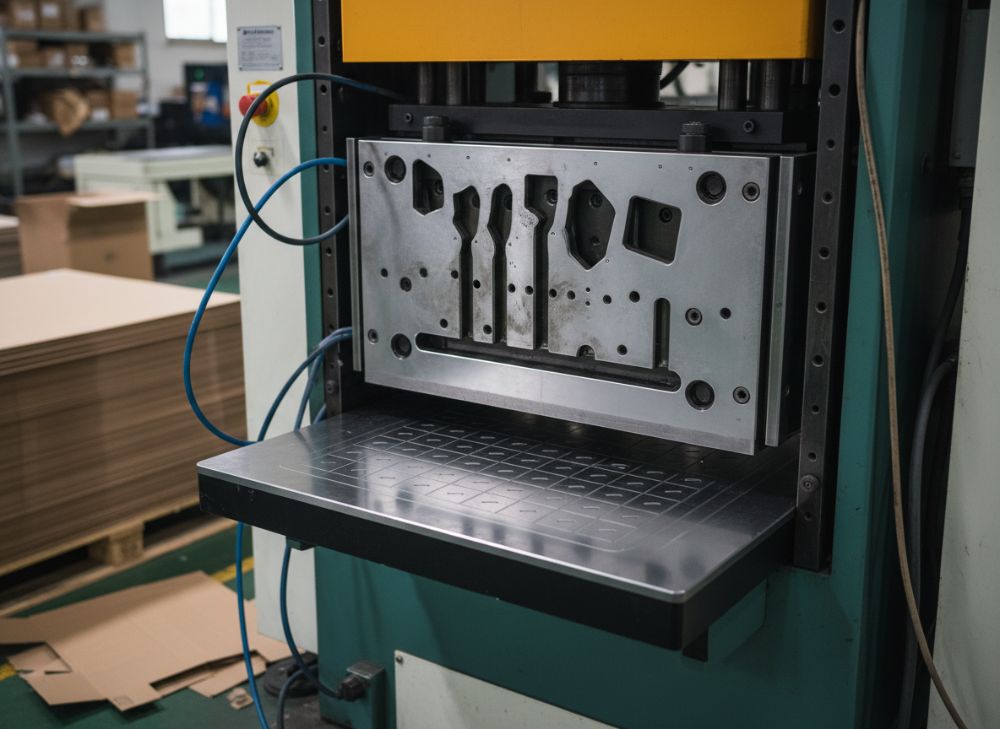
Printing plates and cutting dies are common one-off costs for packaging that uses conventional print processes or custom shapes. A plate transfers artwork in certain printing methods, while a die is used to cut, crease, emboss or foil-stamp a particular format. Not every project needs both, but they can be essential where the design, format or finish requires them.
The issue is rarely the existence of setup charges. It is whether they are clearly separated from the per-unit price and whether you know when they will be charged again.
Ask the following questions:
- Which plates, dies or other tools are required for this specification?
- Is each charge included in the quote, excluded, or estimated?
- Is the tooling cost per colour, per size, per design or per version?
- Who retains the tooling after production?
- Can it be reused for repeat orders with the same artwork and dimensions?
- What changes would require replacement tooling?
A quoted carton price may look low if the die charge is excluded. Conversely, a higher unit price may include setup and become better value over a larger run. Compare the total order cost, not the unit price alone.
When setup costs are most likely to matter
Setup charges deserve particular attention when you have:
- A bespoke structural design rather than a standard box style
- Foil blocking, embossing, debossing or other specialist decoration
- Multiple printed versions with different artwork
- A small initial order
- Frequent seasonal, promotional or product-range updates
If a standard format meets the product’s protection and presentation requirements, it may reduce tooling complexity. Buyers specifying custom boxes should provide finished dimensions, product weight, desired board type and closure requirements early, as late structural changes can affect both tooling and material use.
Proofing and Sampling Fees
A digital proof, a printed proof and a physical packaging sample are different things. A digital proof is useful for checking layout, spelling, placement and general artwork approval. It may not fully represent the colour, texture, construction, finish or fit of the final packaging.
A printed or physical sample can involve material preparation, print setup, finishing, hand assembly or bespoke tooling. It may therefore carry a separate charge, particularly for complex packaging. Do not assume that “proof included” means every type of proof is included.
Clarify what the supplier will provide before production:
| Approval stage | What it can help check | What to confirm |
|---|---|---|
| Digital artwork proof | Copy, layout, barcodes, positioning and design approval | Number of revisions included and format supplied |
| Printed colour proof | Colour appearance and print detail | Substrate, print method and whether it represents final production |
| Structural sample | Size, assembly, product fit and opening experience | Whether it uses final materials, finishes and closures |
| Pre-production sample | Overall specification before the full run | Cost, lead-time effect and approval process |
Colour expectations need careful management. Screen colours and printed colours can differ, while the same artwork may look different across board stocks, coatings and printing methods. If colour consistency is commercially important, give a clear reference and ask how it will be assessed. Any relevant market, product or labelling requirements should also be verified for your product before print approval.
A practical mistake is approving a proof before final product samples are available. The packaging might be visually correct but too tight, too loose or unsuitable for the way the product is packed. Build product-fit checks into the approval process where possible.
Expedited Shipping Costs
A short deadline can create costs well beyond a faster transport service. Expedited production may require altered scheduling, priority handling, partial shipments or a different delivery method. These charges can be significant and are often only visible once an artwork delay or launch-date change has occurred.
To avoid avoidable expediting costs, establish the production timeline in stages:
- Artwork supplied
- Proof issued
- Proof approved
- Sample approved, where required
- Production starts
- Goods are ready for dispatch
- Delivery is booked
Ask whether the quoted timeline begins at enquiry, order confirmation, final artwork approval or payment clearance. These are not interchangeable dates. A buyer who assumes the clock starts at enquiry may discover too late that production cannot begin until a final proof is signed off.
Also clarify whether the quote is for one complete delivery. Splitting a shipment may solve an immediate stock issue, but can add packing, handling and transport costs. If delivery timing is critical, ask for a standard option and an expedited option in writing rather than assuming either is available.
Minimum Order Quantity (MOQ) Traps
Minimum order quantity, usually shortened to MOQ, is not always a hidden fee. It can, however, create hidden financial exposure when the minimum is higher than your practical demand, storage capacity or artwork lifespan.
A supplier may quote an attractive price at a quantity that is commercially unrealistic for your business. Ordering more units generally reduces the apparent unit cost, but it also commits cash, warehouse space and stock to a design that may change.
Compare at least three quantities:
- Your immediate operational requirement
- A sensible repeat-order quantity
- The supplier’s most economical quantity band
Then calculate the fully landed cost of each option, including setup, delivery, storage and expected wastage. The lowest unit cost is not necessarily the lowest cost of ownership.
Questions to ask about MOQs
- Is the MOQ per box style, artwork version, colourway or SKU?
- Can different artwork versions share a total print run?
- Does every SKU require separate tooling or setup?
- Are over-runs or under-runs possible, and how are they charged?
- Is the MOQ based on finished units, sheets, rolls or another production measure?
- What happens if you need a small top-up order?
This is especially relevant for branded labels. A label order may be economical at a high volume but become obsolete following a recipe, ingredient, barcode, design or legal-information change. When ordering custom stickers and labels, check whether the quoted quantity is practical for the expected life of the information printed on them.
Storage and Inventory Fees
Large packaging orders can shift cost from production to inventory. If a supplier holds raw materials, printed sheets, finished boxes or labels on your behalf, there may be storage, handling, stock-management or release fees. These may be charged monthly, per pallet, per release or when stock remains beyond an agreed period.
Storage arrangements can be useful when you want to benefit from a longer production run while taking deliveries in stages. They only work well when the terms are clear.
Confirm all of the following:
- What stock will be stored: raw material, work in progress or finished goods
- The free storage period, if any
- The charge after that period and how it is calculated
- Minimum release quantities and release notice requirements
- Pick, pack and dispatch fees for each call-off
- Responsibility for damage, ageing, stock counts and obsolete packaging
- What happens to remaining stock if the design changes or an agreement ends
For gift packaging, seasonality makes this particularly important. A premium gift box may be ordered ahead of a campaign, but a design tied to a date, event or limited range can lose value quickly. Buyers of gift packaging should align order quantities with campaign timing and agree a stock-release schedule before committing.
Do not regard supplier-held stock as automatically flexible. It is inventory you have funded or committed to, so it should be managed with the same discipline as stock in your own warehouse.
Artwork Revision Charges
Artwork changes can be inexpensive at an early stage and costly once files have been approved, plates made, materials ordered or production started. Some suppliers include a stated number of artwork checks or minor amendments. Others charge for each revision, particularly where a change affects pre-press work, tooling, layout or print setup.
“Artwork supplied” should not be treated as a simple yes-or-no condition. Define what the supplier expects. The production-ready file may need correct dimensions, bleed, safe areas, colour settings, fonts, image resolution, die lines and finishing instructions. Missing information can lead to extra work or delays.
Before work starts, establish:
- Who is responsible for final artwork accuracy
- The file format and artwork specification required
- What counts as a minor amendment versus a new version
- How many proof rounds are included
- The charge and timing for further changes
- Whether corrections after written approval incur additional costs
- How final approved files will be identified and controlled
Common costly mistakes include updating one panel but not another, approving an old file version, omitting product information, and failing to account for a barcode quiet zone or finishing area. Use a named file version, a dated approval record and a single accountable approver. These simple controls reduce the likelihood of paying for corrections that could have been caught before print.
Tooling Maintenance Costs
Custom dies, plates and other reusable tools may not be permanent assets. They can wear, become damaged, be archived, require maintenance or eventually need remaking. This can cause a surprise cost on a repeat order, especially if the buyer assumes a previous setup fee guarantees indefinite reuse.
Tooling maintenance is more relevant for designs with repeat cutting, creasing or decorative processes, and for packaging purchased over several years. It may also matter if the supplier has a retention policy that limits how long tools are kept after the last order.
Ask for the tooling policy in writing:
- How is tooling identified and stored?
- How long is it retained after the most recent production run?
- Is maintenance included, charged separately or assessed when needed?
- Who authorises replacement tooling?
- Can the tool be transferred, and under what conditions?
- Will the supplier notify you before disposal or replacement?
There is an important limitation here: no supplier can reliably promise that a tool will remain usable forever. The useful commercial protection is transparency. A quote should state whether a repeat order is priced on the assumption that existing tooling is serviceable and explain how a replacement would be handled.
Understanding Freight and Duties
Freight and duties are often treated as a separate subject, but they belong in any realistic packaging budget. Transport can be quoted as an estimate, excluded entirely, included only to a stated point, or changed by factors such as shipment size, packing method, destination and dispatch timing.
For UK buyers, establish exactly where responsibility transfers and which charges are included in the stated figure. If packaging is produced outside the UK, import processes can add further uncertainty. Duties, import VAT, customs clearance, inspections, document preparation and domestic onward delivery may be handled by different parties depending on the agreed terms.
Request an answer to these questions:
- Is delivery included, and to which address or delivery point?
- Is the quoted transport cost fixed, estimated or subject to change?
- Does the price include export packing, loading and shipment documentation?
- Who acts as importer of record where relevant?
- Who is responsible for duties, import VAT, customs clearance and related fees?
- Are unloading, timed delivery, tail-lift or restricted-access charges excluded?
- Is transit insurance included, optional or unavailable?
Avoid comparing a delivered quote with an ex-works or collection-only quote as though they were equivalent. The lower figure may simply leave more costs for the buyer to arrange. Likewise, do not assume a supplier’s transport estimate covers every border, clearance or final-delivery cost; ask for the commercial terms and inclusions in plain language.
How to Compare Packaging Quotes Fairly
Create a one-page comparison sheet for every supplier. This makes omissions visible and prevents a low headline price from driving the decision.
| Cost area | Include in comparison | Why it matters |
|---|---|---|
| Product specification | Size, material, print, finish, quantity and pack format | Confirms you are comparing like with like |
| One-off costs | Plates, dies, sampling, artwork and setup | Can dominate the first-order cost |
| Repeat-order costs | Unit price, tooling assumptions and revision policy | Reveals the long-term cost |
| Inventory commitment | MOQ, over-runs, storage and call-off terms | Affects cash flow and obsolescence risk |
| Delivery cost | Freight basis, delivery point and excluded services | Determines the actual landed cost |
| Import exposure | Duties, VAT, clearance and responsible party | Prevents unbudgeted charges |
| Change control | Charges for amendments, delays and cancellation | Limits cost escalation after approval |
A robust quote should identify the specification it is based on, the validity period, payment assumptions, lead-time assumptions and exclusions. If an item is uncertain, ask the supplier to label it as an estimate and explain what could alter it. That is more useful than accepting a supposedly all-inclusive number with undefined conditions.
XGolden Print has experience in custom packaging and printing, but the same buyer discipline applies to any supplier: provide a complete brief, request an itemised proposal and retain written approval of the final specification. You can also review the supplier background through the XGolden Print company overview before beginning a detailed quotation process.
FAQ
Are setup charges always a bad sign in a packaging quote?
No. Setup charges can reflect genuine work needed to produce a custom format or print finish. They become a problem when they are undisclosed, unclear or unexpectedly repeated. Ask what the charge covers and whether it can be reused on future orders.
Is a lower unit price always better for custom packaging?
No. A lower unit price may require a much larger MOQ, create storage costs or exclude freight and setup. Compare the total cost for the quantity you can realistically use, not only the per-unit figure.
Should I approve packaging from a digital proof alone?
A digital proof is useful for artwork checks, but it may not confirm product fit, material feel, construction or final printed appearance. Consider the risks of your product and request the appropriate proof or sample stage before committing to full production.
What should be included in a packaging purchase order?
Include the approved artwork version, dimensions, material, print and finish details, quantity, unit price, one-off charges, delivery terms, payment terms, timeline assumptions and any agreed storage or call-off arrangements. Attach or refer to the final approved proof where possible.
Before accepting a custom packaging quote, turn every assumption into a written line item or a stated exclusion. That single step makes supplier comparisons clearer, protects your budget and gives your team a firmer basis for approving the right packaging specification.