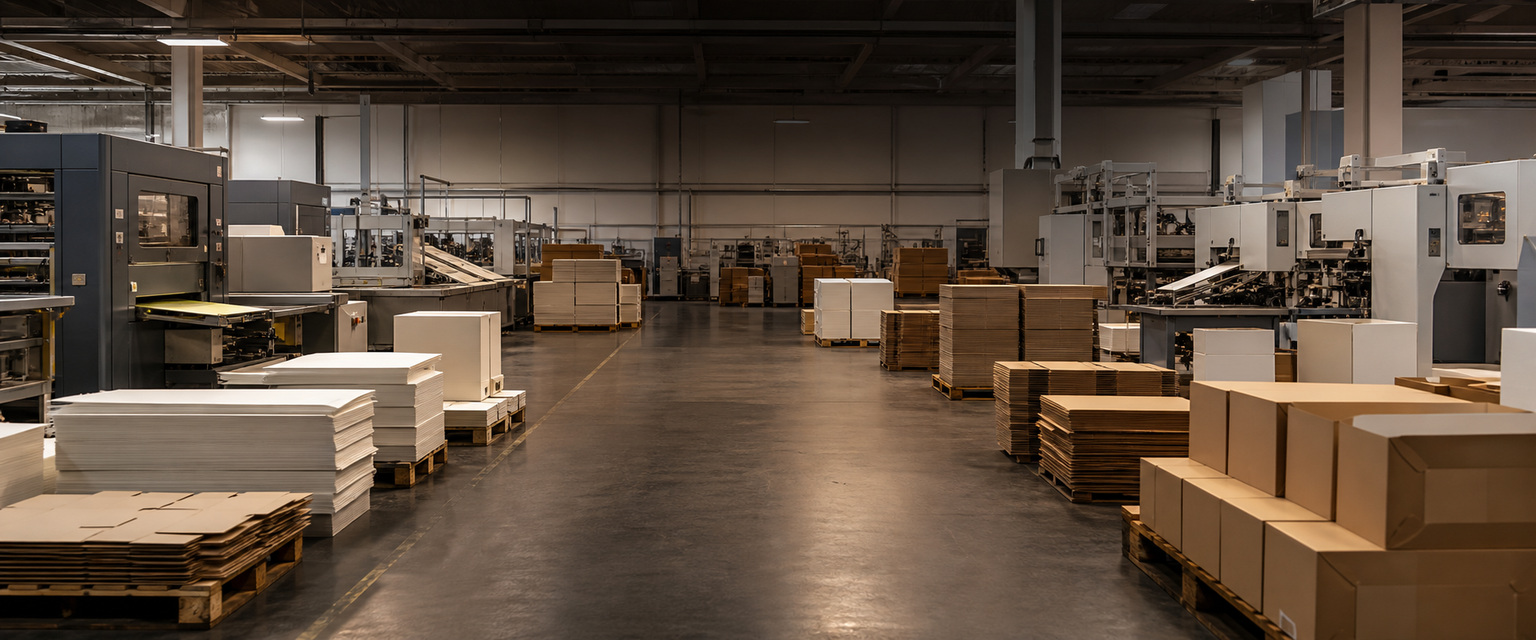
Custom paper box packaging can lower shipping costs when it is designed around the actual product, packing method and parcel service rather than chosen from a stock size. The biggest savings usually come from reducing parcel dimensions, avoiding unnecessary weight, limiting void fill and preventing the cost of damaged deliveries.
In practical terms, the 5 ways custom paper box packaging can lower your shipping costs are: use dimensions that sit efficiently within carrier bands, choose an appropriate paper stock, create a close product fit, add strength where it protects the shipment, and supply boxes flat for more efficient storage. The choices below can also improve purchasing, fulfilment and returns costs.
Before changing a box, gather a representative sample of packed orders. Record the product dimensions, packed weight, external box size, protective materials used and the parcel tiers applied by your chosen delivery services. This gives you a baseline for comparing packaging options rather than judging a box by unit price alone.
Optimising Dimensions to Meet Carrier Tiers
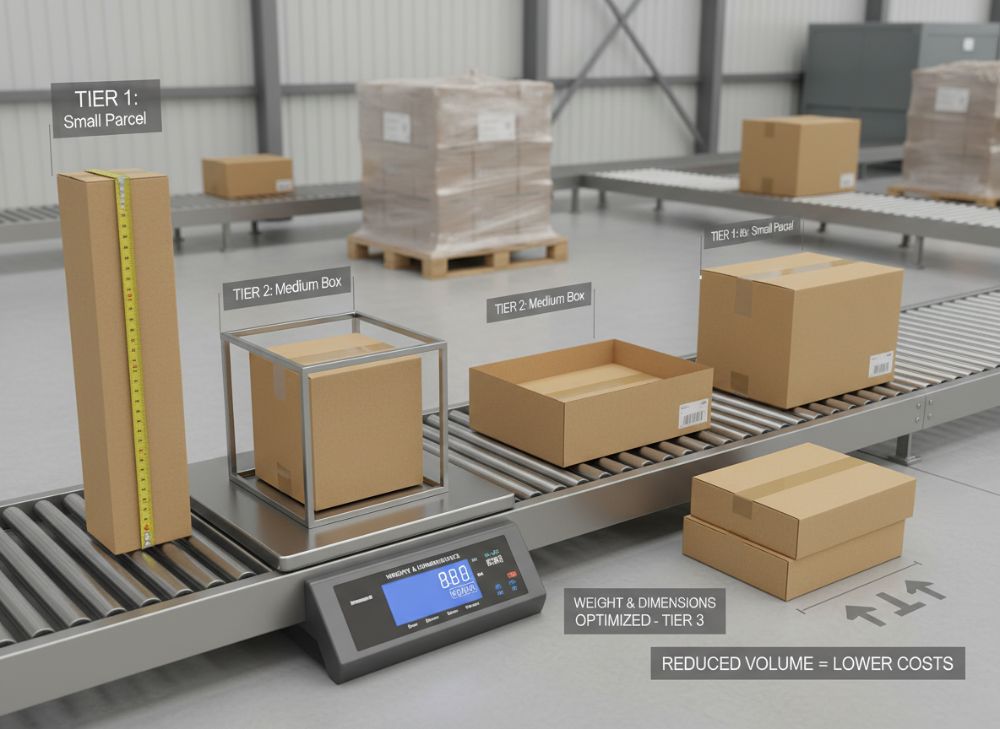
Parcel charges are commonly influenced by weight, size, or both. A box that is only slightly wider, longer or taller than necessary can move a consignment into a more expensive category, particularly where a service uses volumetric weight or maximum dimension thresholds.
Custom dimensions allow you to build the box around the product and its necessary protection. The goal is not the smallest possible box; it is the smallest reliably packable box that protects the item throughout storage, handling and delivery.
When specifying dimensions, work from the inside out:
- Measure the product at its widest, tallest and longest points.
- Allow space for any required wrap, tissue, inserts or dividers.
- Account for tolerances in product size and packing.
- Add the board thickness when calculating external dimensions.
- Check the final packed parcel against the size and weight rules of each delivery service you use.
Avoid designing from product dimensions alone
A common error is to specify internal dimensions that match the product exactly. In reality, a tight box may slow packing, crush corners during closing, or make it difficult for customers to remove the item. Conversely, excessive clearance can require more paper void fill and increase the external parcel size.
For products with several variants, assess whether one adaptable box size can handle a sensible range of items. A single size may simplify stock control, but it can become costly if it leaves every order with significant unused volume. Often, a small family of box sizes gives a better balance between operational simplicity and shipping efficiency.
Check outer dimensions after assembly
Flat box dimensions are not necessarily the same as their assembled external dimensions. Ask the packaging supplier which measurements are internal, external or panel dimensions, and confirm how the stated board grade affects the finished size. This matters when orders sit close to a carrier threshold.
Carrier rules and pricing structures vary, so always verify current dimensional limits, volumetric calculations and surcharges directly with the services in your delivery mix.
Choosing Lightweight Yet Durable Paper Stock
A lighter box can reduce the total parcel weight, but a board that is too light for the product and distribution journey may deform, split or offer insufficient stacking protection. The appropriate choice is therefore the lightest paper-based construction that remains suitable for the product, packing process and expected handling conditions.
Paper box packaging may use folding carton board, corrugated material or a combination of materials. Their suitability depends on factors such as product weight, shape, fragility, moisture sensitivity and whether boxes will be stacked or sent individually.
| Packaging consideration | A lighter specification may suit | A more robust specification may be needed |
|---|---|---|
| Product weight | Small, light products | Heavier or concentrated loads |
| Product fragility | Products with their own protective casing | Glass, ceramics or easily dented goods |
| Shipping format | Multi-item cartons or protected consignments | Individual parcel delivery |
| Product shape | Stable, evenly supported items | Sharp edges, irregular forms or protrusions |
| Handling requirement | Short, controlled handling chain | Multiple handling points and stacking |
The board grade alone does not determine whether a box is fit for purpose. Structure matters too. A well-designed locking base, reinforced corners, internal support or appropriate closure can give a lightweight pack better practical performance than a heavier but poorly constructed alternative.
Consider the whole packed weight
It is easy to focus on the box material and overlook the rest of the pack. Review the combined weight of:
- The product
- The outer box
- Inserts, dividers and protective wrapping
- Labels, documents and sealing materials
- Any secondary transit packaging
A modest reduction across several components may be more useful than changing board weight alone. However, do not remove protection simply to reduce grams. The cost of replacements, customer service and resending an order can outweigh the saving from a lighter parcel.
For an accurate specification, provide your supplier with the product weight, dimensions, distribution method and any known packing constraints. If the product is especially delicate, arrange your own representative packing and transit assessment before committing to a large run.
The Role of Fit in Minimising Void Fill
The right fit reduces the need for loose protective material. Less void fill can lower material use, packing time, parcel weight and external dimensions, while helping keep the product from moving inside the box.
A tailored paper box can use internal folds, collars, trays, partitions or inserts to hold a product in a predictable position. This is particularly helpful for items that would otherwise shift from side to side, such as bottles, sets, electronics accessories or gift items.
Choose the appropriate type of internal support
Not every product needs a complex insert. Match the interior solution to the risk:
- Simple clearance: Suitable for stable, low-risk products that need only a small amount of protective wrap.
- Folded paper insert: Useful for holding lightweight goods in place without adding a separate component.
- Divider: Helps keep multiple items apart within the same box.
- Tray or platform: Can present a product neatly and reduce movement.
- Custom-shaped insert: May suit unusually shaped, delicate or premium products, but adds design and assembly considerations.
The optimum fit should allow consistent packing by different team members. If an insert is difficult to assemble or requires the product to be positioned with great precision, it can slow fulfilment and introduce errors.
Do not over-engineer the unboxing experience
Premium presentation can be commercially valuable, particularly for custom gift packaging, but unnecessary layers add weight, volume and handling steps. Review every component and ask whether it has a protective, functional or brand purpose.
For example, a printed sleeve, tissue layer and rigid-style insert may be appropriate for a high-value gifting product. The same arrangement could be an avoidable cost for a simple replenishment item. Design the pack around the actual customer experience and delivery route, not a one-size-fits-all idea of premium packaging.
Reducing Damage Rates with Stronger Boxes
A box that protects the item properly can lower the risk of costs associated with damaged deliveries. Those costs may include replacement stock, additional packaging, reshipment, refunds, handling time and customer dissatisfaction.
Strength does not always mean using the thickest material. Better protection may come from improving the box structure, securing the closure, adding local reinforcement or keeping the product from striking the walls of the pack.
Useful design features to review include:
- A base construction suitable for the product’s weight
- Locking tabs or a closure method that remains secure during handling
- Reinforced panels around vulnerable areas
- Corners designed to resist crushing
- Inserts that stop products colliding with one another
- Adequate clearance between the product and outer walls
- A layout that keeps printed surfaces from scuffing during packing
Match protection to the actual distribution risk
An item delivered in a larger shipment may need a different pack from the same item sold directly to a customer. Direct-to-consumer parcels can experience more handling points and may be packed with unrelated items in transit. A retail-ready carton may therefore not automatically be suitable as a postal box.
Similarly, a box that performs well for a lightweight product may not suit a heavier version in the same product range. Avoid simply scaling up dimensions without reviewing the base, closure and board construction.
If packaging will carry fragile goods, food-contact items, cosmetics, children’s products or regulated products, confirm the relevant material, labelling and compliance requirements for the intended UK market with suitable specialists. Packaging design alone does not establish compliance.
Flat-Packed Paper Boxes for Storage Savings
Flat-packed paper boxes can use less warehouse space before assembly than pre-formed packaging. Better storage density can reduce the space required for packaging inventory and make it easier to hold an appropriate range of sizes.
This can have a knock-on effect on shipping operations. When packaging stock is easier to store near packing benches, teams may be less likely to substitute an oversized box simply because the correct size is unavailable or inconvenient to access.
Flat-packed designs are particularly useful when:
- Storage space is limited
- Demand changes through the year
- Several product sizes need separate packaging
- Packaging is assembled as orders are picked
- Businesses want to reduce the volume of inbound packaging deliveries
The trade-off is assembly time. A box that ships flat but takes too long to erect may increase labour costs and slow dispatch. Request samples or production-ready blanks and have the people who pack orders assess the folding sequence, closure and label placement.
Balance storage efficiency with packing speed
The best flat-packed design is not always the one with the smallest storage footprint. Look for a format that is intuitive to assemble, maintains its shape once erected and does not require excessive tape or additional components.
Document a simple packing method for each box type. Clear instructions, visual references and sensible workstation layouts help teams pack consistently, reducing the chance of incorrect assembly or unsuitable substitutions.
Negotiating Bulk Rates with Packaging Suppliers
Buying packaging in larger quantities can reduce the unit cost, but the lowest unit price is not automatically the lowest overall cost. A large order may tie up cash, consume storage space or leave you with obsolete stock if a product changes.
A better approach is to negotiate using a clear forecast and a specification that is stable enough to repeat. Share anticipated annual demand, preferred batch quantities, expected design changes and storage constraints. This helps suppliers identify practical production quantities and may make it easier to compare options fairly.
When reviewing supplier quotes, compare like with like:
- Box style and finished dimensions
- Paper or board specification
- Print colours, finishes and coverage
- Inserts, dividers and additional components
- Whether prices include tooling or set-up where applicable
- Packing format and quantity per bundle
- Delivery terms and lead-time assumptions
- Tolerance expectations and proof approval process
Calculate landed packaging cost, not just unit cost
A lower unit price may be offset by greater inbound transport, additional storage, higher waste or slower assembly. Consider the cost per packed and dispatched order, including the packaging material, labour, storage and expected protective performance.
For a growing range, consider whether repeatable structural formats can share common features while using different printed artwork. This may simplify ordering without forcing every product into an unsuitable size.
XGolden Print offers custom packaging boxes and printing solutions. When comparing suppliers, provide the same brief to each one so dimensions, material assumptions and finishes can be assessed on an equivalent basis.
Designing Boxes for Automated Fulfilment
Packaging that works in a manual packing station may not work as well in an automated or semi-automated fulfilment process. Box design can affect how reliably packaging is erected, filled, closed, labelled and scanned.
Even if full automation is not currently in place, considering these requirements can make a design more resilient as operations grow.
For boxes intended for automated fulfilment, assess:
- Whether blanks separate cleanly from a stack
- Whether panels fold in a clear, repeatable sequence
- Whether locking tabs engage consistently
- Whether the box holds its shape before filling
- Whether label areas are flat, visible and large enough
- Whether barcodes remain scannable after application
- Whether closures interfere with conveyor movement or handling
- Whether product inserts can be placed consistently
Keep operational surfaces clear
Highly decorative packaging can sometimes complicate labelling. Glossy, textured, heavily embossed or irregular surfaces may affect how labels adhere or scan. Reserve a suitable, accessible panel for operational labels, and test it with your actual label stock and application method.
If you use custom printed stickers and labels, check the final label size, adhesive, surface compatibility and position alongside the box design. The label should not cover critical product information, interfere with opening or crease across a fold.
Do not assume a box is automation-ready because it looks simple. Run small operational trials with your own products, labels and handling equipment before standardising the design.
Reusable and Returnable Packaging Solutions
Reusable or returnable packaging can reduce the need for replacement packs in selected business models, but it is not suitable for every product or delivery journey. It works best when there is a practical way to recover the packaging and when customers or business recipients have a reason to return it.
For consumer deliveries, a reusable paper box might use a second closure strip or a structure that can be resealed for returns. This can make a return easier to manage without requiring the customer to find a new box. For business-to-business circulation, returnable packs may be more viable where deliveries follow predictable routes.
Consider these questions before choosing a reusable design:
- Will customers realistically keep, reuse or return the packaging?
- Does the product have a return pattern that justifies a resealable format?
- Will the box remain protective after it has been opened?
- Does a second closure add material, complexity or assembly time?
- Can returned packaging be inspected, cleaned where needed and reused appropriately?
- Is the added packaging cost justified by the likely reuse cycle?
Make returns easy, but do not compromise protection
A resealable feature should not weaken the original closure. The pack must still protect the outward shipment, and the return mechanism must be understandable without excessive instructions.
Paper-based packaging can support simple, practical return journeys, but it should be assessed alongside product hygiene, condition requirements and the handling process for returned goods. For some products, a straightforward recyclable pack may be more appropriate than a reusable format.
A practical checklist before ordering custom boxes
Use this checklist to turn the packaging review into a buying decision:
- Map your current parcels. Record product dimensions, packed size, packed weight and protective materials.
- Identify costly exceptions. Look for oversized parcels, high void-fill use, difficult packing steps and recurrent damage issues.
- Set the protection requirement. Define what the product must withstand in its actual distribution journey.
- Choose a small number of sensible sizes. Avoid both uncontrolled size proliferation and a single oversized universal box.
- Confirm dimensions and material assumptions. Establish whether measurements are internal or external and how the box will be supplied.
- Trial the full packing process. Test assembly, packing, labelling, sealing, storage and customer opening.
- Compare total cost. Include materials, packing time, storage, inbound handling and delivery implications.
- Review periodically. Changes to products, order profiles or carrier terms can alter the best packaging choice.
The most cost-effective custom box is one that fits the product, works at the packing bench and aligns with the parcel services you actually use. Begin with your most frequently shipped products or the orders that repeatedly fall into costly size bands, then compare a few practical structural options before placing a larger order.